
evergreen guide
Build Wedge Gaps From Your Actual Yardage Problem First
A practical method for identifying whether a missing wedge, a loft change, or no purchase at all will solve the awkward approach distance in your bag.
Built for: Golfers who have an awkward distance gap near the green and are considering a gap, sand, or lob wedge.
The frustrating shot is not always a sign that you need more loft. Start with the carry window you cannot cover, then choose only the wedge feature that addresses that observable problem.
The quick verdict
Buy another wedge only after you can name the specific carry-distance hole or shot task it must cover; loft is the first feature to address a distance hole, while sole and bounce questions belong to a separate contact-and-lie assessment.
Best for Golfers who repeatedly face a known in-between approach distance and can record several normal, on-course-style shots with the clubs already in the bag.
Skip it if Skip a purchase for now if the problem changes from shot to shot, you have not measured the carry patterns of your current wedges, or the club would duplicate a distance you already cover.
Begin with the shot that keeps producing indecision
A golfer stands 70 yards from the green, catches a pitching wedge too hot, then tries to guide a more-lofted wedge and comes up short. That sequence feels like a swing problem, but the first question is simpler: is there a repeatable carry window that no current club covers comfortably? Write down the situation, the intended landing area, and which two clubs leave you choosing between too much and too little. A purchase earns its place only when it reduces that recurring decision.
Guild recommendation: Define the problem as one missing carry window or one clearly stated shot task before looking at a wedge.
Use loft to solve a distance hole, not a label
Wedge labels can distract from the decision. A club called a gap wedge is useful only if its loft creates a sensible progression from the pitching wedge through the rest of your set. Put the actual lofts of those clubs in order, then compare them with the results of the Carry-Window Check. If the largest uncovered space sits immediately below the pitching wedge, the candidate should be selected for its ability to fill that space, rather than because a category name sounds right. If two existing clubs already produce overlapping normal carries, adding another club in the same part of the set is unlikely to clarify an approach shot.
Guild recommendation: Choose a candidate loft only after you have identified which adjacent clubs leave the recurring carry window.
Keep distance gapping separate from turf interaction
A distance problem and a contact problem may show up on the same hole, but they call for different questions. If the ball routinely finishes beyond or short of a chosen landing area despite normal contact, begin with the loft progression. If the carry choice is clear but the club behaves unpredictably from your typical sand, fairway, or rough lie, make that a fitting conversation about sole and bounce options. Do not use a sole feature as a substitute for a missing carry window, and do not expect a new loft alone to settle an inconsistent lie-specific result.
Guild recommendation: For a contact or lie concern, bring examples of your usual course conditions to a qualified fitting discussion rather than guessing from a product listing.
Let the whole bag decide whether there is room
Every added wedge changes the rest of the bag. Before committing, identify which existing club would leave and whether that club creates a larger scoring problem than the wedge solves. A complete equipment review matters here: the PGA of America describes club fitting as an evaluation of both the golfer and the complete equipment setup. That wider view protects the golfer who solves an 85-yard uncertainty only to remove a club needed far more often elsewhere. If you play under rules of golf, verify that any final club choice conforms with the applicable equipment rules.
Guild recommendation: Bring your full loft list and the club you would remove to a fitting, rather than evaluating the prospective wedge in isolation.
A simple decision map for gap, sand, and lob choices
Choose a gap-oriented loft when the demonstrated problem is a carry hole between the pitching wedge and the next wedge. Consider a sand-oriented choice when you have already accounted for the loft sequence and your unresolved need is a dedicated club for the bunkers and lies you actually play. Consider a lob-oriented choice when a specific short-sided, high-lofted task remains uncovered after the rest of the progression makes sense. None of those labels guarantees a better score on its own. The right choice is the one that turns an identifiable hesitation into a repeatable club-and-landing-area decision.
Guild recommendation: If you cannot finish the sentence, “I need this club for this shot from this range,” retain the current setup and gather more on-course observations.
Try this · 25 to 35 minutes.
The Carry-Window Check
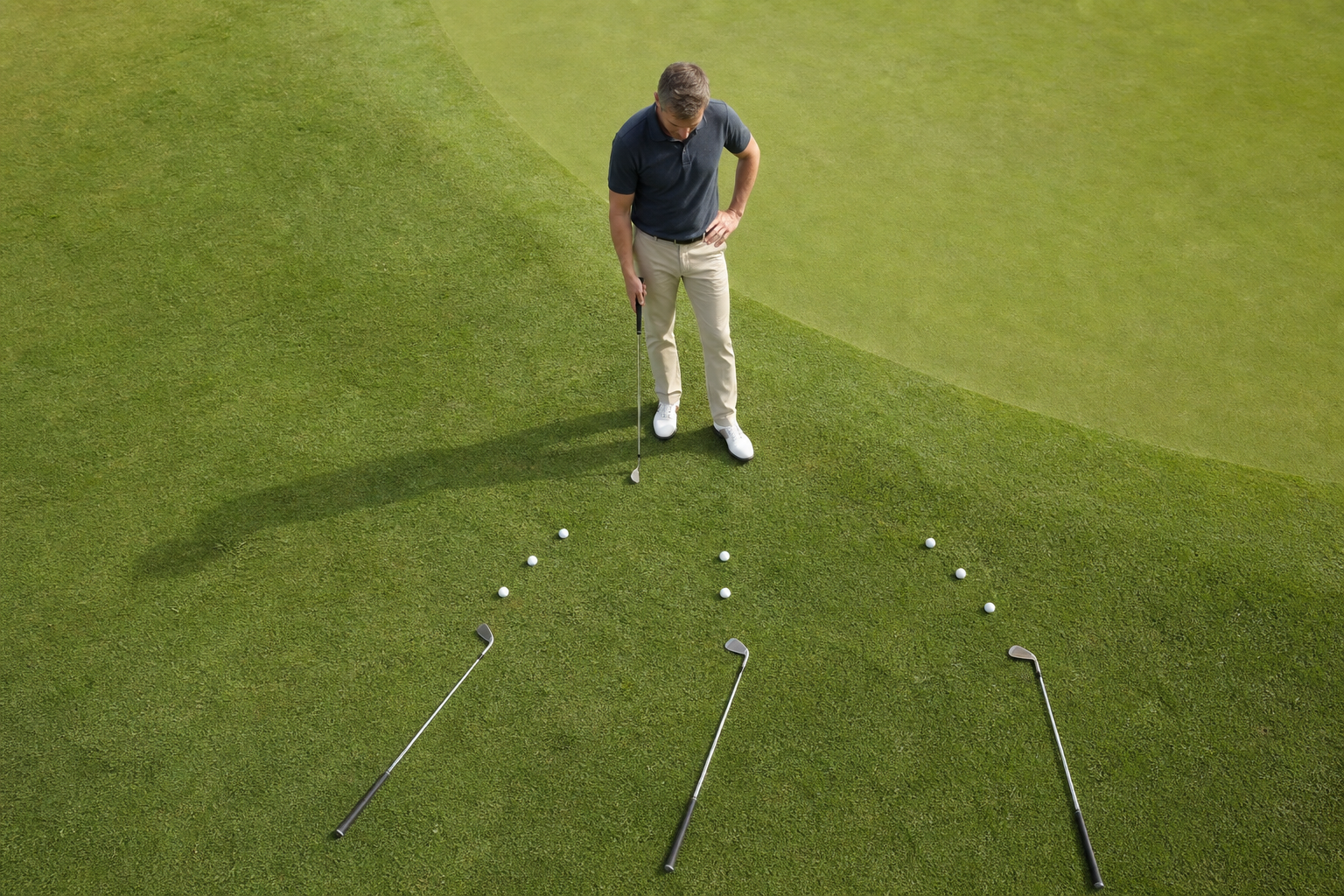
Use a quiet practice area with safe targets or clearly chosen landing areas. Bring your pitching wedge and every wedge currently in the bag, one type of ball, a notebook, and enough space to make normal partial and full wedge swings safely.
- Choose one repeatable swing length that you would use for a scoring approach, rather than trying to hit every ball as hard as possible.
- Hit five balls with one club toward the same landing area and write down the carry result or the relative landing zone for each ball.
- Repeat the same five-ball set with each remaining wedge, keeping the ball, target, and intended swing length unchanged.
- Circle the two neighboring clubs whose normal results leave the largest usable space between them, then repeat only those two sets once to see whether that space appears again.
- Write down the real course shot that falls in the open window, such as an approach that repeatedly asks for less than one club and more than the next.
What progress looks like: The practice is useful when the same uncovered carry window appears across the repeat sets and you can describe the shot it would solve in one sentence.
Put the guide to work
These searches are a starting point—not a substitute for the fit and comparison criteria above.
Compare gap-wedge loft options
Use this search after your carry-window check identifies a distance hole between your pitching wedge and the next lofted club.
Compare sand-wedge sole options
Use this search only when your main need is a repeatable club for the lies and turf conditions you face, not simply another number on the sole.
Compare lob-wedge loft options
Use this search when you can name a specific high-lofted shot requirement that your present wedges cannot cover without an uncomfortable manipulation.
If you buy through these links, Guild of Golf may earn a commission at no extra cost to you.
The practical takeaway
- Measure the recurring carry window before selecting a wedge category.
- Use loft progression to address a distance hole, then assess sole and bounce questions separately for your typical lies.
- A new wedge should solve a defined scoring situation without creating a larger hole elsewhere in the bag.
- A complete-bag fitting is more useful than choosing a wedge from a label alone.
Frequently asked questions
How do I know whether I need a gap wedge?
You may need one when repeated, comparable shots show a usable carry window between your pitching wedge and the next wedge, and you can identify a real course situation that falls in that window.
Should I choose a sand wedge because I struggle from bunkers?
First confirm that your loft progression is sensible, then discuss your usual bunker and lie conditions as a separate fitting question. A bunker concern does not automatically identify the right loft or sole option.
Can I build wedge gaps without a launch monitor?
Yes. Use consistent balls, a repeatable swing length, a safe target area, and several shots per club. The goal is not perfect measurement; it is finding whether the same decision gap appears repeatedly.
Why does the rest of the bag matter when buying one wedge?
Adding a club may require removing another one. Reviewing the full setup helps ensure that the new wedge solves a more important problem than the club it replaces.
Sources used for this draft
- PGA of America: Club Fitting — The recommendation to evaluate wedge choices in the context of the golfer and the complete equipment setup.
- USGA Equipment Rules — The reminder that club design and conformance are governed by equipment rules.
Guild of Golf may earn a commission from qualifying purchases made through shopping links, at no additional cost to the reader.