
comparison
Forged vs. Hollow-Body Irons: Choose for the Miss You Can Measure
A practical fitting-first guide to separating iron construction labels from the ball-flight and strike-pattern evidence that should guide a purchase.
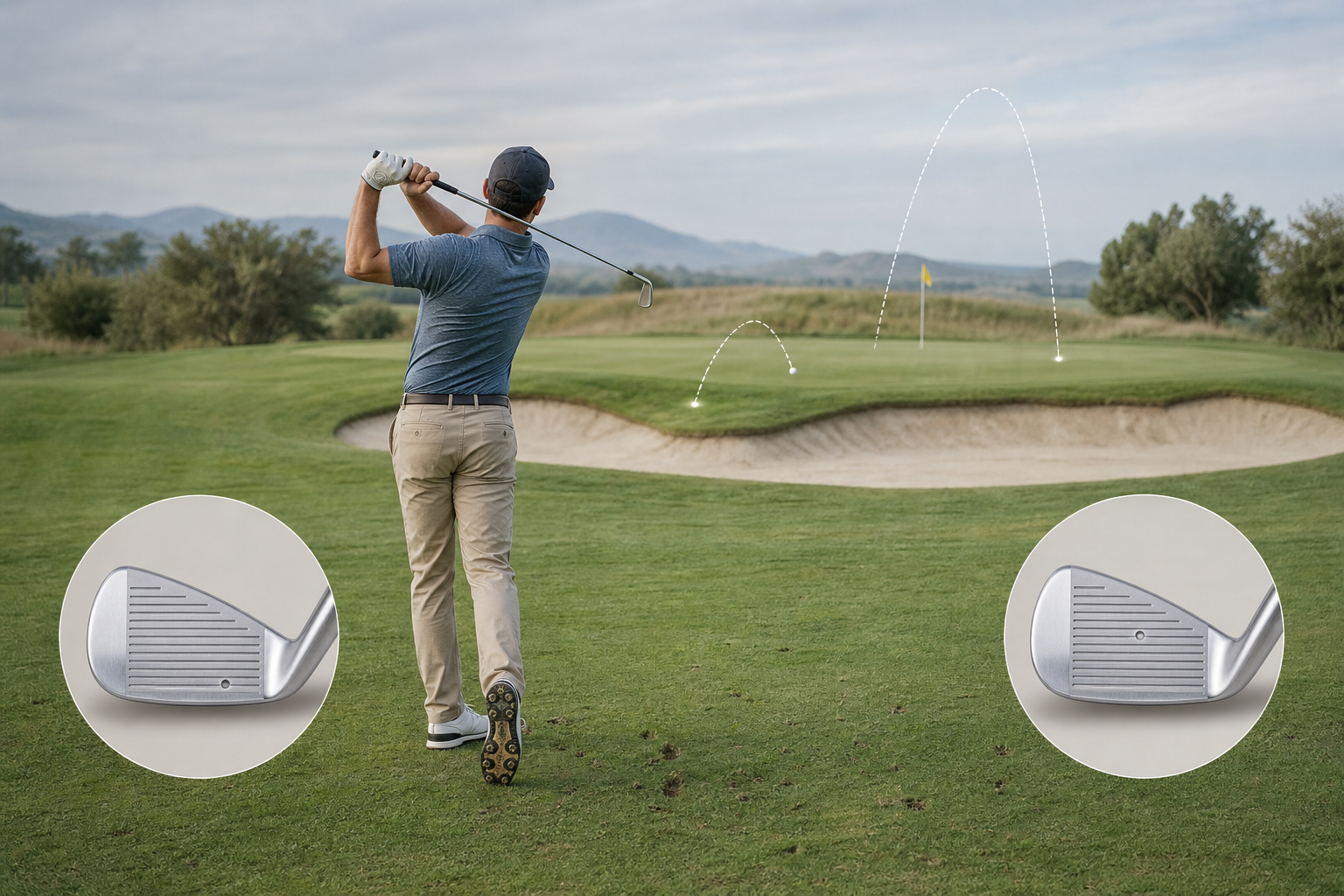
Built for: Golfers comparing iron constructions who want to separate manufacturing terms from on-course fit and performance.
A pure strike on the range can make any iron decision feel obvious. The useful question comes later: when contact moves toward the toe, or a forced carry must clear trouble, which head gives you a result you can repeat?
The quick verdict
Forged and hollow-body are construction labels, not a reliable shortcut to the right iron. Choose the option that improves the specific ball-flight, distance-control, or strike-pattern problem you can observe in a measured comparison.
Best for Golfers willing to compare their normal shots, including imperfect strikes, and use fitting results to judge carry, start line, trajectory, dispersion, and usable distance gaps.
Skip it if Skip a construction-led purchase if you have not identified a performance problem or cannot compare clubs under similar conditions; the label alone cannot establish fit.
The first question is not what the head is called
Picture a par 3 with a bunker guarding the front. Your usual iron reaches the green only when contact feels exceptional; ordinary shots finish in the hazard. That is an observable carry problem. It is more useful than beginning with a preference for forged or hollow-body construction.
Now picture the opposite player: the approach routinely reaches the green but flies an unpredictable distance or finishes too far left and right. That player has a distance-control or dispersion question. A different construction label may be worth comparing, but it is not the answer by itself.
Construction terms tell you something about how an iron is made. They do not, on their own, tell you what your launch, carry, landing pattern, or gapping will be. The USGA’s conforming-club requirements apply regardless of marketing category or construction method, so neither label is a special exemption from the equipment rules.
Guild recommendation: Write down one performance problem in plain language before browsing: a carry you do not clear, a distance gap you cannot manage, or a pattern that leaves too many poor approach locations.
Make a forged comparison answer a measurable question
A forged option belongs in the comparison when a golfer wants to evaluate the complete club package against a specific outcome. Do not let an appealing strike sensation end the process. A satisfying feel can matter to confidence, yet it should sit beside evidence from your normal shots.
For example, a golfer who repeatedly leaves approaches short might compare whether a forged candidate reaches a defined landing area often enough to make the front trouble irrelevant. A golfer who already covers that carry might instead compare whether the candidate produces a tighter usable landing window. The key constraint is the same: use the shot you actually face, not a single perfect range ball.
Keep the comparison fair. Use a similar target, a similar number of normal swings, and the same idea of success for each option. PGA of America fitting guidance emphasizes fit and measured results when comparing club options.
Guild recommendation: Consider forged irons when you can evaluate them against an outcome you value, but skip a purchase based solely on label, appearance, or one especially good strike.
Make a hollow-body comparison answer a different measurable question
A hollow-body option should earn its place in the bag by changing a problem you can see. A player who needs to cover a specific carry more regularly may ask whether the candidate turns more normal strikes into shots that reach that zone. Another player may need a more dependable separation between neighboring irons, especially if several clubs finish at similar distances in routine play.
There is a tradeoff in every comparison: a change that improves one outcome may not improve another outcome you care about. That is why a fitting conversation should include more than the longest shot. Ask what happens to the bulk of the shots, where they land, and whether the resulting set still leaves useful gaps for the approach distances you face.
Do not assume hollow-body construction is automatically the better choice for a golfer who misses the center, or automatically the wrong choice for a golfer who values control. Those are claims a measured comparison must settle for the individual golfer.
Guild recommendation: Compare hollow-body irons if a defined carry, gapping, or ordinary-strike outcome needs improvement, and reject the candidate if it does not improve that priority under comparable conditions.
Use the fitting bay to protect the course decision
A fitting is most productive when the golfer arrives with a question rather than a verdict. Bring the result of the ten-ball check: perhaps most shots are short of a carry, perhaps the impact pattern is scattered, or perhaps the issue is inconsistent landing distance. Then ask to compare options using your normal swing and the same target task.
Record the outcomes that affect real approaches. Carry matters when a bunker, water, or front edge demands it. Left-right spread matters when the green is narrow or a penalty area waits on one side. Distance gaps matter when the next club is often either too little or too much. A club that looks impressive in isolation may be less useful if it does not improve the constraint you brought to the session.
Finally, verify that any club you intend to play conforms to the applicable rules. Conformance is independent of whether the club is described as forged or hollow-body.
Guild recommendation: Ask the fitter to compare normal-shot results and your usable set gaps, then choose the construction only after one option demonstrably addresses your stated problem.
Try this · 20 minutes.
Ten-Ball Carry-and-Contact Check
Use one familiar mid-iron, one consistent target, and a clear landing area at a practice range. Place a small alignment marker on the ground aimed at the target, and use face-safe impact spray or impact tape if permitted by the product instructions.
- Hit five normal shots with no attempt to change your swing, recording whether each ball finished short of, near, or beyond your intended landing area.
- Note the general impact pattern on the clubface after the first five shots, without assigning a swing fault to it.
- Hit another five normal shots toward the same landing area and record the same outcomes.
- Review the two groups together. Look for the most common miss: insufficient carry, excessive carry, a wide left-right spread, or contact clustered away from the center.
- Take that single recurring outcome to a fitting comparison and ask to see whether another iron option changes it while you keep a normal swing.
What progress looks like: You finish with one plainly stated, repeatable performance question, such as whether a comparison iron produces more shots that reach a chosen carry area without widening the left-right pattern.
Put the guide to work
These searches are a starting point—not a substitute for the fit and comparison criteria above.
Forged iron sets
Use this search after deciding to compare measured carry, dispersion, trajectory, and distance gaps rather than assuming the construction label supplies a result.
Hollow-body iron sets
Use this search when you have a specific observable issue to test, such as shots failing to cover a required carry or inconsistent distance through the middle of the set.
Face impact spray for golf clubs
A face-marking aid can help document general strike location during the practice check before a fitting comparison.
If you buy through these links, Guild of Golf may earn a commission at no extra cost to you.
The practical takeaway
- Forged and hollow-body describe construction; neither label alone establishes on-course fit.
- Choose one observable problem before comparing irons, such as a required carry, uncontrolled landing distance, or broad directional spread.
- Judge candidates on normal shots and the outcomes that matter for your common approach situations.
- Measured fitting results are more useful than a construction-based assumption.
- Confirm applicable club conformance independently of the construction category.
Frequently asked questions
Are forged irons automatically better for feel?
Feel is a valid personal preference, but the supplied evidence does not establish a universal feel ranking by construction. Treat feel as one part of the decision and confirm that the club also improves the measured outcome you need.
Are hollow-body irons automatically better for distance?
No construction label alone establishes your distance result. Compare normal-shot carry and the spacing between clubs, then select the option that improves the distance problem you actually have.
What should I bring to an iron fitting?
Bring a clear description of one observable pattern, such as repeated short approaches or unreliable carry over trouble. PGA of America guidance supports using fit and measured results when comparing options.
Do forged and hollow-body irons follow different conformance rules?
No. The USGA states that conforming-club requirements apply regardless of marketing category or construction method.
Sources used for this draft
- USGA Equipment Rules — The point that conforming-club requirements apply regardless of construction method or marketing category.
- PGA of America: Club Fitting — The recommendation to use fit and measured results when comparing club options.
Guild of Golf may earn a commission from qualifying purchases made through its shopping links, at no additional cost to the reader.