
evergreen guide
Choose a Game-Improvement Driver by Your Strike Pattern, Not the Label
A practical framework for choosing a more playable driver by identifying your common strike location, shot pattern, launch window, and most manageable miss.
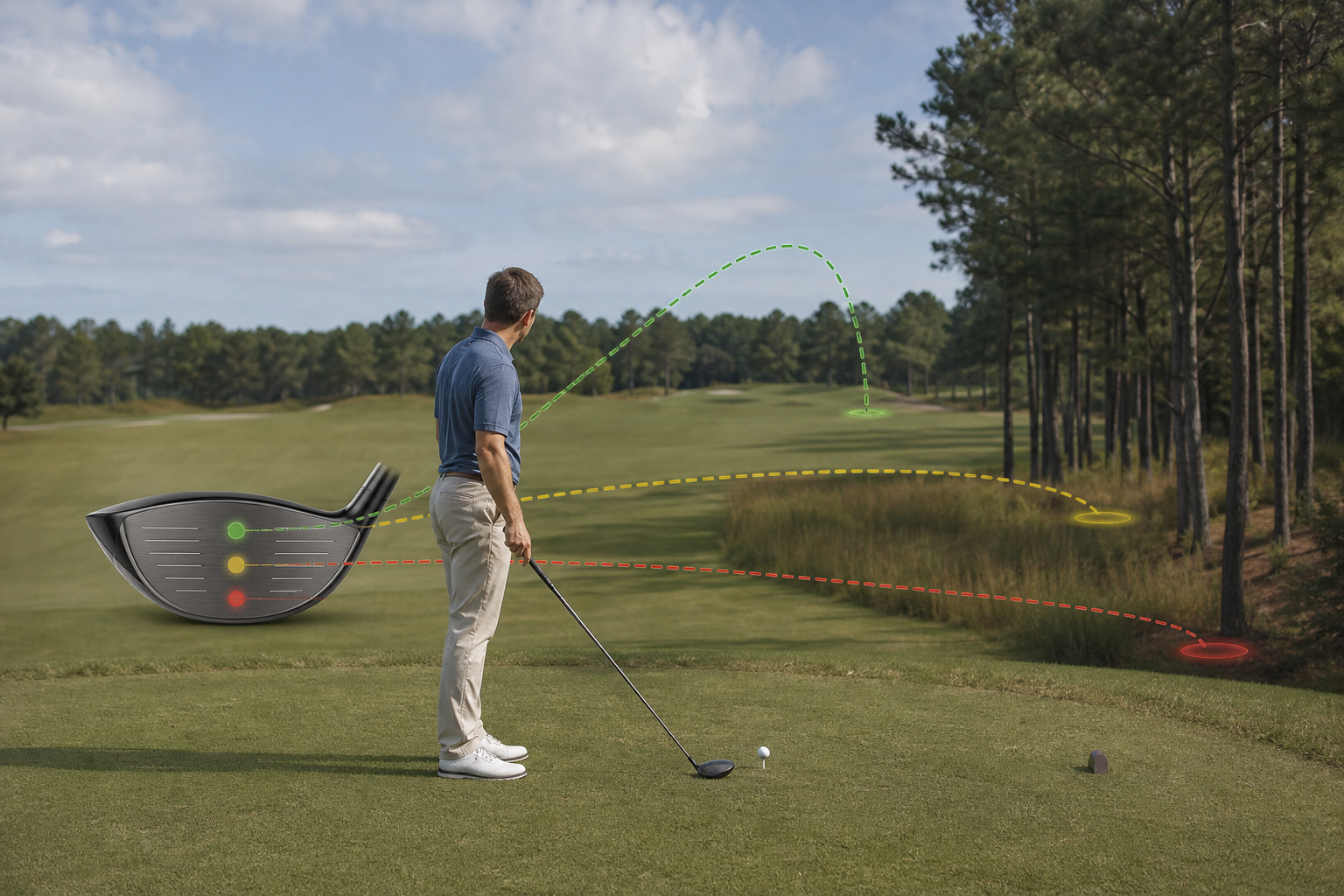
Built for: Golfers seeking a more playable driver who want to evaluate strike consistency, dispersion, launch, and confidence without relying on a vague game-improvement label.
The driver that helps is not necessarily the one with the most forgiving label. Start with the shot that puts you in trouble, verify where you strike the face, then compare only the designs and fitting variables that can make that miss more playable.
The quick verdict
Choose a driver to improve the miss you actually repeat: a head and setup that preserve usable tee shots on your typical strike are more valuable than a broad game-improvement category.
Best for Golfers who can describe their usual tee-shot problem in observable terms, such as a repeated heel strike, low-face contact, a consistent right-side finish, or a ball that launches too low to carry trouble.
Skip it if Skip a purchase decision based on labels alone if your strike pattern changes wildly from swing to swing; first collect a modest sample of shots or work with a fitter to measure the results.
Begin with the hole that keeps costing you
A golfer standing on a tight par 4 rarely needs a driver described as forgiving in the abstract. They need one that turns their familiar bad swing from a lost-ball search into a shot from light rough, or that carries the bunker they repeatedly find when contact is low on the face. That is the useful definition of playable: the result leaves an option for the next stroke.
Start by naming the outcome, not the club feature. “I lose everything right” is incomplete. “My usual drive starts right and finishes behind trees” is actionable. So is “my drives launch low and fail to clear the cross bunker,” or “my solid shots are fine, but heel strikes peel into the right rough.” A category label cannot establish which of those problems you have.
Use a recent round, a range session with a defined target, or a fitting session to separate your best drive from your common one. The club should be judged on the latter. A driver that produces a spectacular outlier but leaves most misses in penalty trouble is not necessarily the more playable choice.
Guild recommendation: Write down one recurring tee-shot outcome and define success as a more manageable next shot, not as one longer drive.
Match the feature to the evidence
Once the pattern is observable, keep the comparison narrow. If impact marks show that you repeatedly miss away from face center, compare candidate heads by how tightly your ball flights and landing areas hold together across that repeated strike. If the problem is low launch that brings a hazard into play, compare launch results and ask whether a different loft setting or fitted combination improves carry without making dispersion worse.
If the ball repeatedly starts or finishes on one side, do not assume that a driver marked for a particular player type will solve it. Compare the actual left-to-right spread and the share of shots that finish in your playable corridor. A slightly shorter average drive that stays in front of the trees can be the better on-course tool.
Shaft selection belongs in this process because the club is a system, not merely a head. A fitting comparison should measure outcomes with the whole club: strike consistency, dispersion, and launch. The PGA of America specifically emphasizes fit and measured results when comparing options. That approach protects you from choosing a driver because its stated purpose sounds familiar rather than because its results answer your problem.
Guild recommendation: For every driver you compare, record the same outcomes: impact location, launch appearance or measurement, starting direction, finish area, and whether the next shot remains open.
Treat launch as a playable-distance question
Launch is most useful when tied to a course constraint. Suppose your normal tee ball must carry a ridge, reach a broad fairway shelf, or clear a bunker. The relevant question is not whether one driver creates an impressive number in isolation. It is whether a repeatable strike produces enough carry to clear that feature often enough, while retaining a pattern you can live with.
The reverse can matter as well. A golfer who already carries the trouble may gain nothing from pursuing a different flight if the resulting shot spreads into hazards. Compare the full pattern: where the shots start, where they land, and what kind of second shot each location leaves. Measured fitting results are especially valuable here because launch, dispersion, and strike pattern can be considered together rather than guessed from a single shot.
Guild recommendation: Define one real carry requirement from your home course, then judge launch changes by whether they clear it without widening your normal miss.
Confidence is evidence when it changes your decision on the tee
Confidence should not mean believing a club is magic. It means the driver lets you choose a sensible target and make a committed swing when the hole narrows. On a hole with water left and trees right, a playable driver is one whose common pattern gives you a target that does not feel like a guess.
This is why a draw-oriented design, a highly stable-looking head, or additional adjustability is not automatically right. Each can be worth exploring only when it addresses the pattern you documented. A golfer whose ball already over-curves left does not need a purchase guided by a generic promise of help. A golfer whose main error is low-face contact should not automatically chase a directional solution before confirming the launch issue.
All clubs used in play must meet the applicable conforming requirements regardless of their marketing category. “Game improvement” is a shopper’s shortcut, not an equipment-rule exemption or a fitting conclusion.
Guild recommendation: Choose the option that gives you a clear target and a repeatable plan on the holes where driver feels most consequential.
Use a fitting session to test a claim, not to hunt a label
Arrive with a question a fitter can test. For example: “My usual poor drive is a heel strike that finishes right. Which setup leaves more of those shots in the playable corridor?” Or: “I need enough carry to clear a bunker, but I do not want a wider spread. Which option improves that outcome?”
Ask to hit enough balls to see a pattern, and compare like with like. Keep the target and evaluation criteria consistent. One unusually long drive does not outweigh a cluster of shots that miss the usable part of the hole. The PGA of America’s fitting guidance supports basing a comparison on fit and measured results.
Leave with more than a preferred model name. You should know the launch and dispersion tradeoff you accepted, the strike pattern the club handled best, and the course problem it is intended to solve. That is a purchase rationale you can revisit when conditions or your game change.
Guild recommendation: Ask the fitter to identify the candidate that improves your common poor-shot outcome while preserving the launch and direction you need.
Try this · 25 to 35 minutes.
Build a Useful Tee-Shot Baseline
Use a driving-range target or a clearly defined fairway-width corridor. Bring your normal driver, tees of one consistent height, and face-impact spray or removable impact tape if available. Mark a starting line and identify a left and right boundary that represent a playable landing area.
- Hit five warm-up drives without judging them.
- For the next 12 drives, use the same target, tee height, and normal on-course swing intention. After each shot, note only three items: face contact location if visible, starting direction, and whether the finish would be in the fairway, light rough, or trouble.
- Group the 12 shots by the repeated outcome rather than your single best drive. For example, note whether most poor shots are low on the face, toward the heel, launched too low, or simply dispersed to one side.
- Hit six more drives while keeping the same target and tee height. Your task is not to rebuild your swing; it is to see whether the same strike and finish pattern remains.
- Take the notes to a fitting session or use them when comparing drivers. Ask for measured comparison of strike consistency, dispersion, and launch with the candidate clubs.
What progress looks like: You finish with a clear description of your most common poor drive, including where it contacts the face and whether it still leaves a realistic next shot.
Put the guide to work
These searches are a starting point—not a substitute for the fit and comparison criteria above.
Driver fitting tools
Use impact feedback to distinguish a repeatable off-center strike from a general dispersion problem before assigning the driver blame.
Forgiving driver comparison
Compare loft options, shaft choices, and head shape only after you know whether your priority is launch, strike retention, or directional containment.
Driver fitting accessories
A visual start line and fairway corridor make range results easier to judge than distance alone.
If you buy through these links, Guild of Golf may earn a commission at no extra cost to you.
The practical takeaway
- A game-improvement label is less useful than a clear description of your repeated poor tee shot.
- Face-contact pattern, dispersion, launch, and the next shot available after a miss are practical comparison criteria.
- Choose features only after identifying the problem they need to address.
- A playable miss may be light rough, short of trouble, or a conservative side of the fairway, depending on the hole.
- Use fitting results to compare whole-club outcomes rather than selecting a head in isolation.
- Conforming requirements apply regardless of how a driver is marketed.
Frequently asked questions
What is a playable miss with a driver?
A playable miss is a result that leaves a realistic next shot. On one hole that may mean light rough instead of trees; on another, it may mean finishing short of water or a bunker. Define it from the hazards and recovery options you actually face.
Should I choose a driver based on where I strike the face?
Yes, if the strike location repeats. Impact feedback can help you distinguish a consistent heel, toe, high-face, or low-face pattern from random contact. Then compare clubs using results from that pattern, especially dispersion and launch.
Is the longest driver always the best game-improvement choice?
No. A longer isolated shot can be less useful than a slightly shorter pattern that stays in a fairway or leaves an unobstructed approach. Compare the landing area and next-shot quality as well as distance.
Can a fitting help if I do not know my swing details?
Yes. Bring observable information instead: your normal miss, typical impact location if known, a course hazard you struggle to clear or avoid, and the kind of poor drive that costs you strokes. Fit and measured results are central to a meaningful club comparison.
Do game-improvement drivers follow different equipment rules?
No. Conforming club requirements apply regardless of marketing category, according to the USGA Equipment Rules.
Sources used for this draft
- USGA Equipment Rules — The point that conforming club requirements apply irrespective of marketing category.
- PGA of America: Club Fitting — The recommendation to compare club options through fit and measured results.
Guild of Golf may earn a commission from qualifying purchases made through shopping links, at no additional cost to the buyer.