
comparison
Putting Mirror vs. Mat: Choose From the Putt You Can Measure
A purposeful guide to choosing a putting mirror or putting mat by starting with an observable home-practice problem, not a feature list.
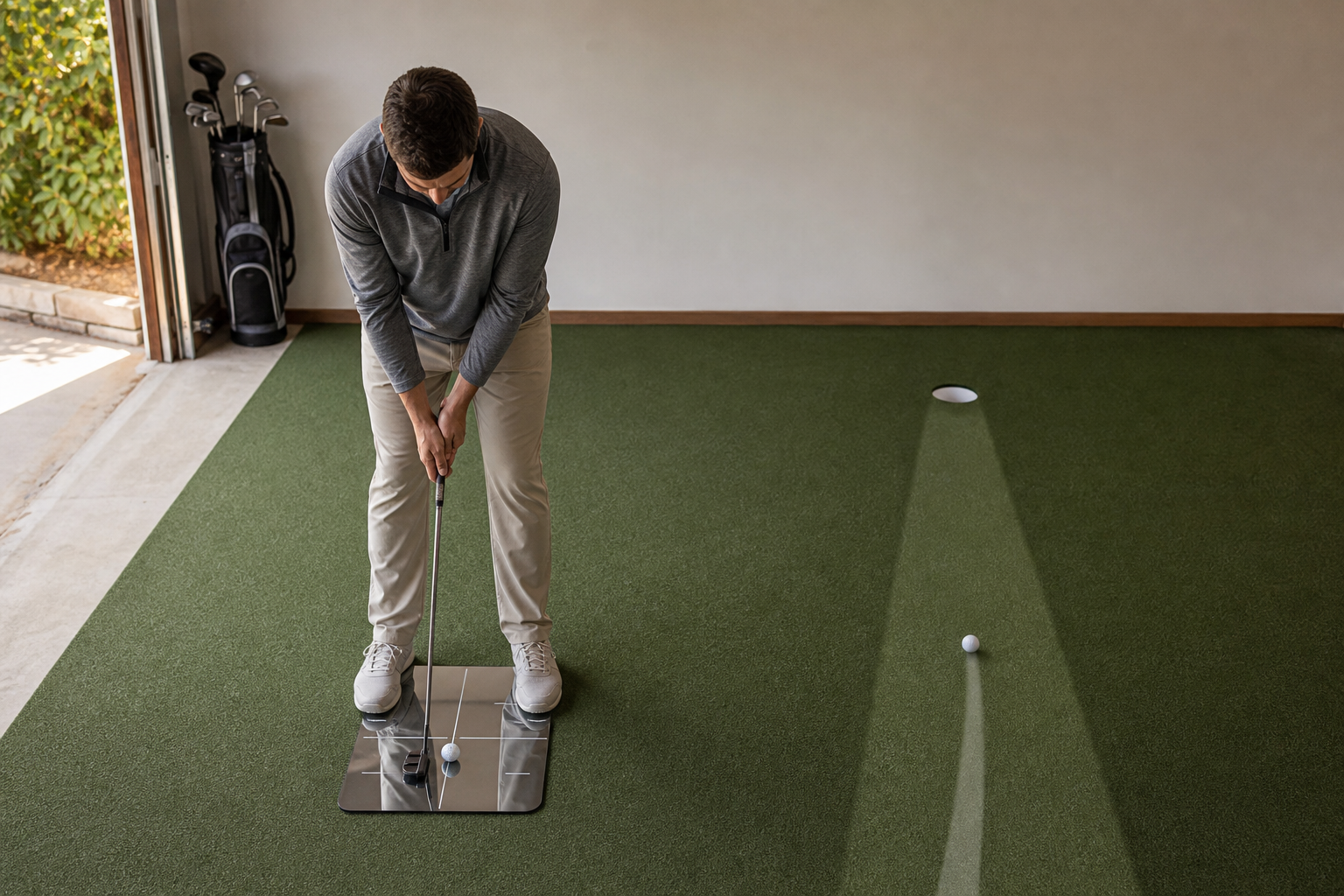
Built for: Golfers choosing one practice aid and deciding whether they need setup feedback or ball-roll feedback.
When a six-footer starts left in the hallway, the useful question is not which aid looks more complete. It is what you can actually observe: an uncertain address position calls for a mirror, while an unclear start-and-finish result calls for a mat.
The quick verdict
Buy a putting mirror when your repeatable, observable concern is how you set up over the ball; buy a putting mat when you need a defined target and repeatable putt outcomes in one home station.
Best for A mirror is best for golfers who want to inspect address and alignment cues before the stroke. A mat is best for golfers who will practice by sending balls to a target and recording makes, misses, and finish location.
Skip it if Skip the mirror if you will not pause to look at setup, and skip the mat if you lack enough uninterrupted floor space to roll putts toward a target safely.
Start with the evidence you can collect at home
A home practice aid earns its place when it turns a vague frustration into one repeatable observation. Picture two familiar sessions. In the first, you stand over the ball, adjust your feet, look down again, and still cannot say what your address position looked like when the putt began. In the second, you make several strokes but have no fixed target or consistent finishing point, so the session ends without a useful score. Those are different problems, and they call for different feedback. Practice has greater value when it has a defined purpose and structure, which makes choosing the problem before choosing the tool the sensible first step.
Guild recommendation: Write down one observable problem before shopping. If the note concerns your position at address, compare mirrors. If it concerns where repeated putts finish, compare mats.
Choose a mirror when the question happens before the stroke
A putting mirror is an address-feedback tool. Its value is not that it makes a putt for you; it gives you a surface on which to check the visual cues you choose before you move the putter. That can suit the golfer who repeatedly changes ball position, cannot settle into the same stance, or wants a compact prompt to pause before beginning a short practice set. Compare clarity first, because an unclear reflection does not support a confident check. Then consider size: a larger surface may make more of your address visible, while a compact format better suits a golfer who must pack practice away after each session. Finally, look at the markings. They should help you inspect one or two cues, not create a crowded checklist.
Guild recommendation: Choose a mirror if you can describe the issue as, “I need to see how I am set before I putt.” Skip it if you mainly want to count rolls to a target.
Choose a mat when the question is where the ball finishes
A putting mat creates a repeatable place to roll balls and a defined target or target area. It suits the golfer whose useful question is outcome-based: did the ball reach the intended finish, and can I repeat that result across several attempts? This makes the mat a practical choice for a short routine built around fixed sets, such as five balls to one target followed by a written total. Measure the available floor before deciding. The mat must fit a safe, uninterrupted lane, and the target needs enough room that a miss does not run into a wall, furniture, or a walkway. A target style also matters: select one you can use to judge a finish consistently rather than one that merely makes the station look elaborate.
Guild recommendation: Choose a mat if you can describe the issue as, “I need a consistent target so I can record what my putts do.” Skip it when your space cannot support a safe, repeatable roll.
Do not buy both to solve an unnamed problem
A mirror and a mat can complement each other, but buying both first can blur the lesson. Suppose a golfer uses a mirror, changes several address details, then rolls putts on a mat and changes the target after every miss. The golfer has added activity without a stable observation. Start with the feature that answers your first question. A mirror is the narrower choice for pre-stroke inspection. A mat is the broader station for repeated rolls and simple result tracking. Add the other only when the first tool has become part of a routine and reveals a second, distinct question.
Guild recommendation: For a one-aid purchase, favor the tool that lets you make one decision after every small set: either “my selected setup cue was consistent” or “this many balls finished at the target.”
Keep home practice connected to golf’s real putting context
Home practice is a place to make a routine more deliberate, not a substitute for observing putts on a putting green. Rule 13 provides the rules context for putting greens and lines of play. Use your home station to rehearse a chosen setup check or collect a simple roll result, then carry that clarity to the course without treating an indoor surface as a complete reproduction of a green.
Guild recommendation: On the course, keep the same single focus from home for a few putts rather than trying to recreate every detail of the practice station.
Try this · 12 minutes.
The One-Observable-Problem Putting Check
Use a level, clear indoor area with a putter, three balls, a cup-sized target or a safe target zone, and either a mirror or mat if you already own one. Set the target at a short, comfortable distance that allows a full roll without furniture or people in the path.
- Write one observation before starting: either “I am unsure where I set up” or “I do not know how consistently I finish at the target.” Choose only one.
- If using a mirror, place a ball in the intended position and take five address positions without hitting. Each time, pause, inspect the same two visual cues you selected, then step away. Hit three putts only after the five setup repetitions.
- If using a mat, roll three sets of five putts to the same target. After every set, record only the number that finishes at the target or in the target zone; do not change the target between sets.
- Finish by naming the single observation that was easiest to repeat. If it was your address check, a mirror matches the job. If it was the counted ball result, a mat matches the job.
What progress looks like: You finish with one simple record: either the same chosen setup cues appeared in five deliberate address positions, or you have three comparable five-putt scores to the same target.
Put the guide to work
These searches are a starting point—not a substitute for the fit and comparison criteria above.
Compare putting mirrors
Compare the usable reflective area, clarity of the surface, and whether its alignment references are simple enough to support the exact address check you intend to repeat.
Compare putting mats
Compare the available roll length, target design, and whether the mat fits a clear area where you can roll the same putt repeatedly and record outcomes.
If you buy through these links, Guild of Golf may earn a commission at no extra cost to you.
The practical takeaway
- Choose from the observable problem, not from the longer feature list.
- A putting mirror is the better first aid for a golfer who needs to inspect a repeatable address position.
- A putting mat is the better first aid for a golfer who needs a fixed target and countable roll outcomes.
- Compare a mirror for reflective clarity, usable viewing area, and uncomplicated alignment references.
- Compare a mat for safe fit, usable roll length, and a target you can score consistently.
- Use short, defined sets and record one result so practice has a clear purpose.
Frequently asked questions
Should a beginner buy a putting mirror or a putting mat first?
Start with the tool that addresses the beginner’s clearest observable problem. Choose a mirror when the golfer needs a simple pre-stroke setup check, or a mat when the golfer needs a repeatable target and a way to count outcomes.
Can I use a putting mirror without a putting mat?
Yes. A mirror can support a short address-position routine in a clear, safe space before you roll putts toward a separate target.
Can I use a putting mat without a putting mirror?
Yes. A mat can support a focused outcome routine when you use the same target, the same distance, and a simple count across comparable sets.
What should I compare before buying a putting mirror?
Compare reflective clarity, the amount of address position you can see, portability, and whether the alignment references help you inspect one or two chosen cues without distraction.
What should I compare before buying a putting mat?
Compare the space required for a safe roll, the usable practice length, and whether the target gives you a consistent way to judge each putt’s finish.
Sources used for this draft
- PGA of America: Practice With Purpose — The recommendation to give practice a defined purpose and structure.
- USGA Rule 13: Putting Greens — The rules context for putting greens and lines of play.
Guild of Golf may earn a commission from qualifying purchases made through the shopping searches.