
comparison
Alignment Sticks vs. Tempo Trainers: Buy for the Fault You Can See
A practical comparison for golfers deciding whether their next inexpensive training aid should target aim and setup or the pace of their motion.
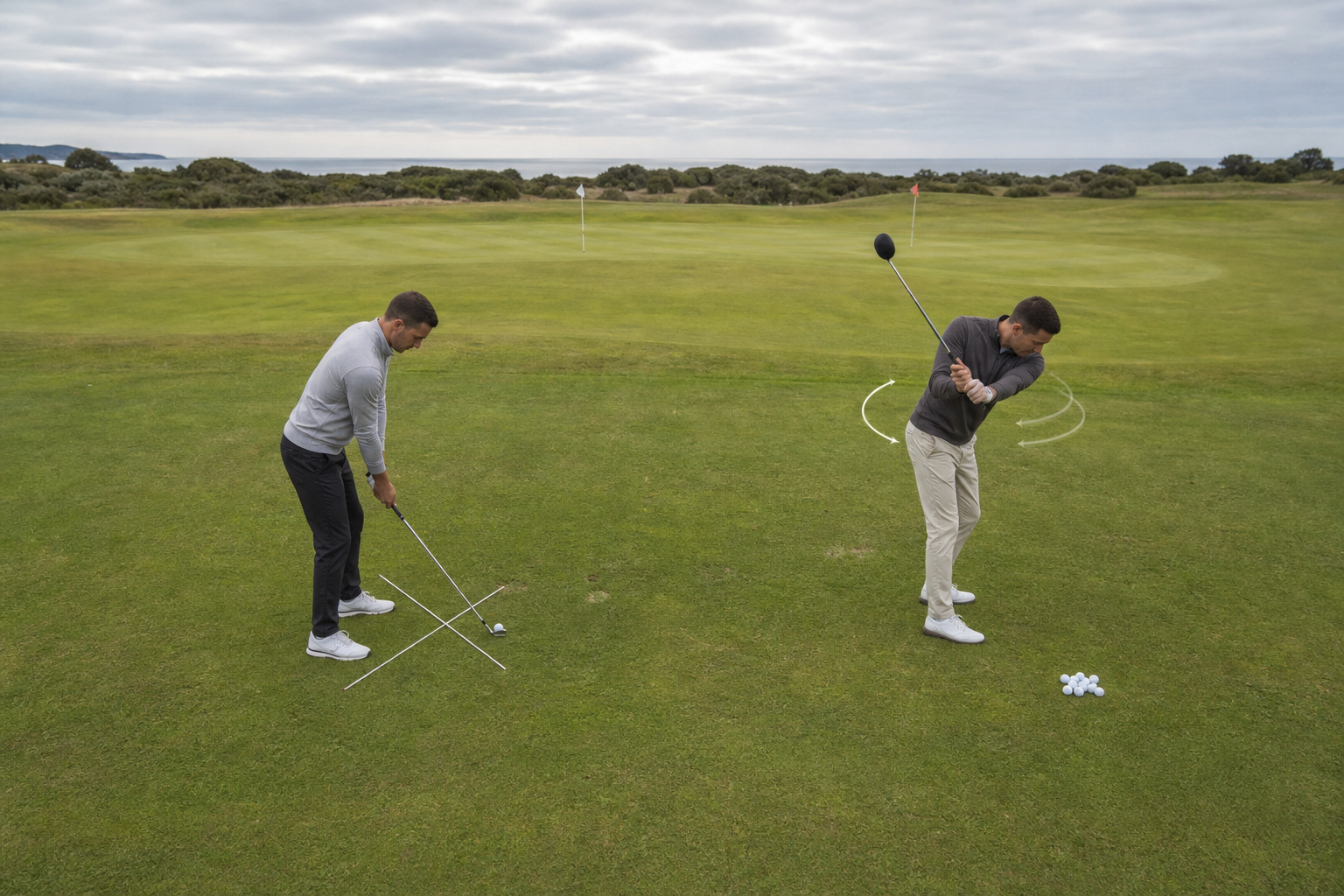
Built for: Golfers choosing between inexpensive practice aids for alignment, movement, rhythm, or speed awareness.
If your practice basket already contains a few half-used gadgets, resist buying another one because it seems broadly helpful. Start with the shot pattern or movement problem you can observe, then choose the tool that makes that one problem harder to ignore.
The quick verdict
Choose alignment sticks when you can point to a repeatable setup or start-line reference that needs checking; choose a swing tempo trainer when your useful practice goal is to notice and repeat the pace of your motion. Neither is a universal swing fix, and the better purchase is the one that gives feedback on the problem you can actually observe.
Best for Alignment sticks suit golfers who want a flexible visual reference for ball position, target line, stance, or a practice station. A tempo trainer suits golfers who are working on a repeatable rehearsal pace and can judge whether consecutive swings feel similarly paced.
Skip it if Skip both for now if you cannot name a specific practice goal or measure a simple outcome. A lesson or a structured practice session may be more valuable when the source of the miss is unclear.
Begin with the miss you can describe
A ball that repeatedly starts left of the intended target creates a different purchase decision from a swing that feels rushed on one shot and slow on the next. Before looking at a training aid, write a sentence that begins, “During practice, I can see that…” Finish it with one observation: inconsistent ball position, an uncertain target reference, or an inconsistent rehearsal pace. Purposeful practice ties the activity to a specific goal, so the tool should make that goal visible rather than promise a complete rebuild.
Guild recommendation: If your sentence describes a location or direction you can set up on the ground, start with alignment sticks. If it describes the cadence of your rehearsal motion, consider a tempo trainer.
Alignment sticks answer a geometry question
Alignment sticks are most useful when the feedback you need is spatial. A golfer preparing for a tee shot can place a stick on the ground as a target-line reference and use another to check whether the ball is being placed in the intended spot relative to the stance. That does not prove why a shot curves or guarantee a straighter ball flight. It does, however, turn a vague thought such as “I think I was aimed correctly” into a repeatable setup check. Their strength is flexibility: a pair can be moved from a target-line station to a ball-position station without asking the golfer to alter the club being swung.
Guild recommendation: Buy alignment sticks if your best next step is to standardize what you can see before the club moves. Skip them if your setup already looks consistent and your real concern is the changing pace of the motion.
A tempo trainer answers a pacing question
A tempo trainer is the more focused choice when your practice issue is not where you stand but whether your rehearsal has a recognizable, repeatable pace. Imagine the golfer who makes a patient practice swing, then snatches the club away when a ball is present. A trainer can give that golfer a dedicated object for slower, controlled rehearsals and a clear comparison between one motion and the next. Its limitation matters: a similar-feeling pace is not evidence that every part of the swing is correct, nor does it identify the cause of every poor strike. Treat it as a rhythm-awareness tool, not as a diagnosis.
Guild recommendation: Choose a tempo trainer when you can use it regularly for controlled rehearsals and judge whether the pace is becoming more repeatable. Skip it if you are really searching for a target-line or ball-position reference.
Do not buy a broad promise when you need narrow feedback
The costly mistake is not choosing the less fashionable aid; it is asking either tool to solve a problem it cannot show you. A player whose shots begin in inconsistent directions may benefit more from a simple station that makes the intended target reference visible. A player whose pre-shot rehearsal changes from hurried to deliberate may get more value from a dedicated pacing cue. If both observations are present, begin with the one that can be checked without interpretation. Often that is the ground reference, because it gives the session a stable starting point. Add a second aid only after the first one has earned a regular place in practice.
Guild recommendation: Use one aid for several short sessions with one stated goal. Keep it only if it produces a repeatable observation that you can carry into normal practice.
Keep practice aids in their proper place on the course
A practice station belongs in an appropriate practice setting, not automatically in play. Equipment and its use during a stipulated round are governed by the applicable Rules, so golfers should confirm what is permitted before using any training aid during a round. The safer habit is straightforward: set up the feedback station during practice, remove it, and play the course with the routine you have rehearsed.
Guild recommendation: Use these tools to organize practice, and consult the applicable Rules before considering any use during a stipulated round.
Try this · 15 minutes.
The One-Variable Feedback Test
On a safe practice area, place two alignment sticks on the ground to create a target-line reference, leaving them well clear of your intended swing path. Choose one club, one target, and a comfortable half-to-three-quarter swing. If you own a tempo trainer, keep it nearby for the second half of the session; do not strike balls with any aid unless its instructions and the practice setting allow it.
- State one observable goal before starting, such as beginning five balls toward the chosen target corridor or making five rehearsals with an even, unhurried pace.
- Hit five balls using only the ground-stick reference. After each shot, note only whether the clubface, ball position, and target reference looked the same at address; do not attempt to diagnose the swing from the result.
- Make five unhurried rehearsals with the tempo trainer, or with your normal club if you do not own one. Pause briefly after each rehearsal and decide whether its pace matched the one before it.
- Return to five balls with your normal club and retain only the single cue that was easiest to repeat: the address reference or the rehearsal pace.
- Write down which cue produced the clearest yes-or-no observation, rather than judging the session solely by the best shot.
What progress looks like: You have a useful buying answer when one tool lets you make a simple observation consistently across several repetitions, while the other leaves the original problem vague.
Put the guide to work
These searches are a starting point—not a substitute for the fit and comparison criteria above.
Compare basic alignment-stick sets
Compare length, visibility, portability, and whether the set provides enough rods to create a ground reference without putting an obstacle near the swing path.
Compare swing tempo trainers
Compare the trainer’s intended practice use, storage length, and whether its feel is suitable for controlled rehearsals in the space where you will actually practice.
If you buy through these links, Guild of Golf may earn a commission at no extra cost to you.
The practical takeaway
- Choose alignment sticks for an observable setup, ball-position, or target-reference question.
- Choose a tempo trainer for an observable rehearsal-pace question.
- A training aid is worthwhile when it gives clear feedback on one defined goal, not when it makes a broad improvement claim.
- Test one variable at a time and judge the session by repeatable observations rather than one exceptional shot.
- Check applicable Rules before using any training aid during a stipulated round.
Frequently asked questions
Can alignment sticks and a tempo trainer be used in the same practice session?
Yes, but give each a separate job. Set the alignment reference first, then make a short block of paced rehearsals, so you can tell which feedback you are using at any moment.
Which should a beginner buy first?
The better first choice is the aid that addresses the clearest observable issue. A beginner who cannot establish a consistent target reference may start with alignment sticks, while one who can set up consistently but cannot repeat a comfortable rehearsal pace may prefer a tempo trainer.
Will either aid fix a slice or heavy contact?
Neither aid can promise that result. They can help structure a specific practice observation, but a recurring ball-flight or contact issue may have causes the aid does not reveal.
Can I use alignment sticks or a tempo trainer during a round?
Do not assume that you can. Equipment and use during a stipulated round are governed by applicable Rules, so check those Rules before using a training aid in play.
Sources used for this draft
- PGA of America: Practice With Purpose — The principle that effective practice should connect an activity to a specific goal.
- USGA Equipment Rules — The reminder that equipment and its use during a stipulated round are governed by applicable Rules.
Guild of Golf may earn a commission from qualifying purchases made through shopping links, at no additional cost to you.