
evergreen guide
Choose a Home Launch Monitor by the Shot Problem You Can See
A practical framework for choosing a personal launch monitor around one observable practice problem, rather than a longer list of metrics.
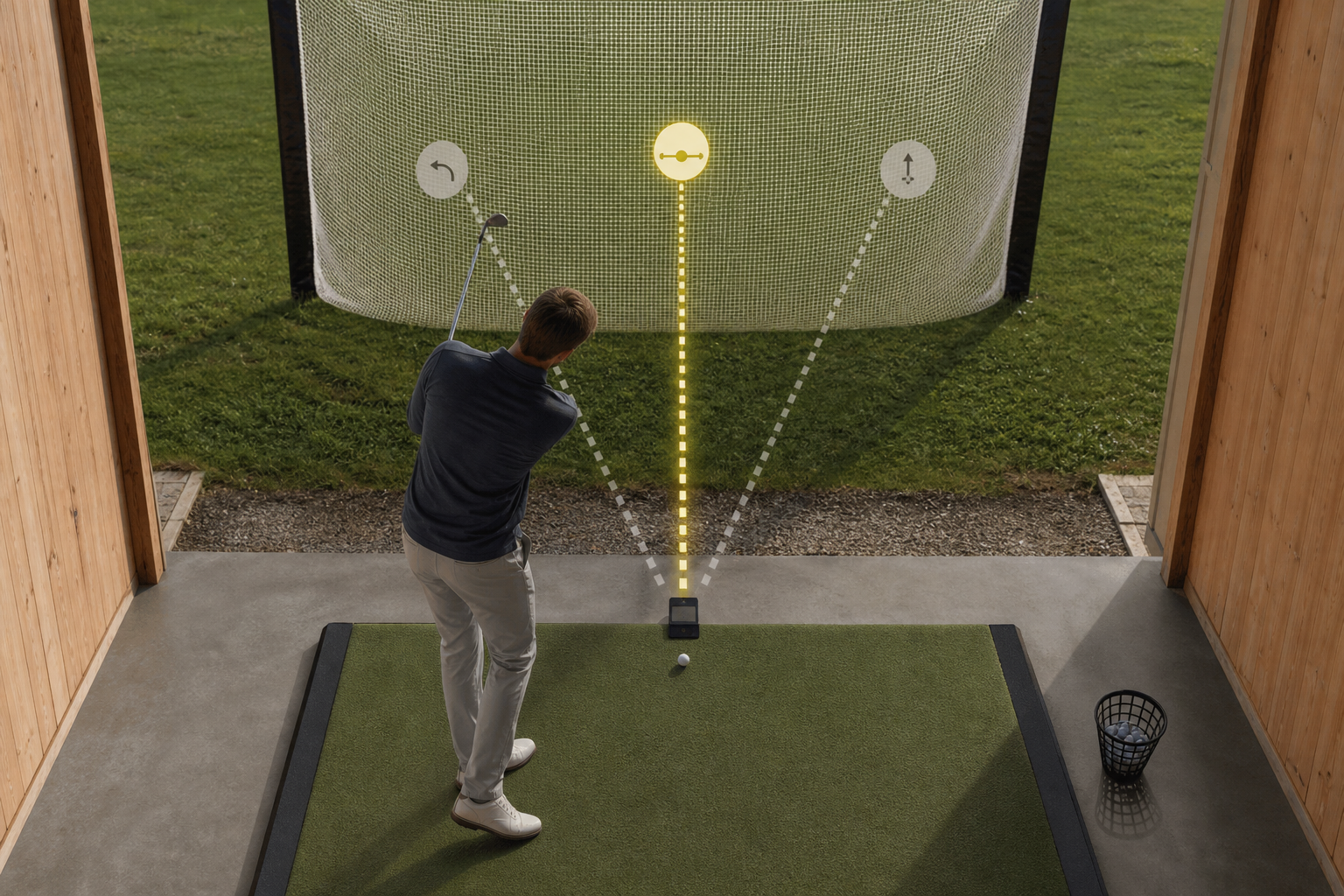
Built for: Golfers deciding whether a personal launch monitor provides the measurements and setup their practice actually needs.
When a seven-iron looks solid but finishes short, or a driver session feels busy without revealing a pattern, more numbers can seem like the answer. Start smaller: identify the shot result you can observe, then buy only the output and setup that lets you measure that result repeatedly at home.
The quick verdict
A useful home launch monitor is one that reliably supports a single, measurable practice question in your available space, with a session flow simple enough that you will repeat it.
Best for Golfers who can name an observable issue, such as unpredictable carry distance or an inconsistent starting window, and will use one reported measurement to track a defined practice task.
Skip it if Skip the purchase for now if you cannot set up a repeatable hitting area, do not know what question you want the data to answer, or mainly need feedback a monitor may not report, such as aim, posture, or strike location.
Begin with the miss you can describe without technology
The tempting home-practice purchase is the unit that offers the longest specification list. That approach can leave a golfer staring at several readings after every ball and learning nothing durable. A better starting point is the result you already recognize on the course or range. Perhaps your pitching wedge sometimes flies well past a familiar target. Perhaps your tee shots begin in an uncertain window. Perhaps high and low iron flights appear in the same bucket of balls.
Turn that observation into one question with a measurable answer. “Do similar seven-irons produce a tighter carry-distance group?” is a workable question. “Why is my swing bad?” is not. Purposeful practice needs a defined purpose and measurable structure, so the measurement should serve the task rather than become the task itself.
Guild recommendation: Write down one shot-result question before comparing any monitor. If you cannot state the question in one sentence, delay the purchase and define the practice problem first.
Match one output to one practice decision
For uneven distance, compare whether a candidate reports the distance output you plan to record and whether it presents that result clearly enough for a short, repeatable session. The outcome is practical: after 10 comparable shots, you should be able to see whether the results cluster or scatter.
For an inconsistent launch picture, compare whether the unit reports the launch-related output you intend to follow. The outcome is not a diagnosis of your technique. It is simply a record of whether the ball-flight result becomes more repeatable during the same task.
For uncertainty about where shots begin, first confirm exactly what directional output the monitor documents. Do not assume that a device can answer a direction question because it records other ball-flight information. If its stated outputs do not answer your question, a larger metric list does not fix the mismatch.
Some visible problems should not drive this purchase. If the real concern is how the club meets the ball, where you are aimed, or how you stand at address, do not presume a launch monitor will provide the relevant feedback. A simple target line, a recorded practice routine, or instruction may be a more direct next step.
Guild recommendation: Reject any candidate that lacks the one output you will log. A measurement you do not use is complexity, not useful practice feedback.
Treat the room as part of the product
A monitor only helps when the setup is repeatable. Before shopping, measure the portion of the room, garage, or outdoor area you can safely dedicate to hitting. Then read each candidate’s stated placement, hitting-area, and environment requirements. Check whether your usual practice arrangement—net or open space, mat or turf, and intended clubs—fits those instructions.
This matters because a monitor that takes too long to place, requires you to move furniture, or forces a different layout every session may turn a useful 20-minute plan into a project. Conversely, a more limited device that you can position the same way twice a week may be the better practice tool for a golfer with a small, stable space.
Also inspect how results are viewed and saved. A visible reading may suit a golfer who wants immediate confirmation of one number. A session record may suit the golfer who wants to compare a 10-shot baseline from Tuesday with the same task next week. Neither approach is automatically better; the right choice follows the review habit you will actually maintain.
Guild recommendation: Make a paper sketch of your practice area and compare it line by line with each manufacturer’s stated setup instructions before you buy.
Ask for supportable claims, not reassuring language
A product page may use broad performance language, but your decision should rest on claims that can be checked. Identify the exact measurement you need, the conditions required to obtain it, how the result is displayed, and whether a session can be reviewed later. For any objective claim that shapes your purchase, look for a reasonable basis in the product documentation rather than relying on vague assurances.
This is especially important when comparing devices by labels such as portable, accurate, or suitable for home use. Those labels do not tell you whether the product fits your room, your practice task, or your preferred review method. The documentation and instructions are where those constraints should become clear.
Guild recommendation: Keep a short comparison sheet with four rows: your practice question, the required output, your available space, and the review method. Leave a candidate off the list when any row is unanswered.
Buy after the comparison, not before it
Once you have chosen the problem and confirmed the setup, compare only the products that meet those minimums. Review the documented measurements first, then the placement requirements, then the result-review process. Battery, connectivity, and portability may matter, but only when they change whether you can complete the practice plan.
For example, the golfer with a garage bay and a weekly seven-iron distance task should favor a monitor that supports that stable arrangement and makes the chosen distance result easy to log. A golfer who practices in different locations should give more weight to stated transport and setup requirements, but still should not compromise on the one needed output. The useful feature is the one that survives the realities of the session.
Guild recommendation: Use the focused searches below only after you have completed your comparison sheet. They are starting points for comparing documented fit, not proof that every result will meet your needs.
Try this · 20 minutes.
The One-Number Baseline Session
Use one club, the same ball type for every shot, a safe home hitting area, and a launch monitor positioned exactly as its instructions require. Choose one target and one available measurement that relates to your observable question; for example, use carry distance when the question is whether similar swings produce similar distances. Keep a notebook or simple score sheet beside the hitting area.
- Write one neutral question before hitting, such as, “How tightly do my seven-iron carry results group today?”
- Hit two easy shots to establish a comfortable rhythm, but do not record them.
- Hit 10 more shots toward the same target with the same club and intended shot. Record only the selected measurement after each shot.
- Circle the highest and lowest readings, then note how many of the other eight sit in a range that feels useful for the shot you are practicing.
- Repeat the identical session on another day before changing your task, club, setup, or selected measurement.
What progress looks like: You finish with two comparable 10-shot records and can describe whether the selected measurement formed a repeatable pattern, rather than relying on memory of a few good shots.
Put the guide to work
These searches are a starting point—not a substitute for the fit and comparison criteria above.
Compare compact home launch monitors
Compare the stated placement requirements, compatible hitting environment, reported measurements, and session-review method against the one question you intend to practice.
Compare launch monitors with carry-distance display
Use this search only if carry-distance consistency is the observable problem you want to track, then confirm that the product documents that output and its required setup.
Compare launch monitors with shot-history review
A saved-session view is worth comparing if your plan depends on reviewing a 10-shot record after practice rather than reacting to one swing at a time.
If you buy through these links, Guild of Golf may earn a commission at no extra cost to you.
The practical takeaway
- Choose a launch monitor from an observable shot-result problem, not from the largest feature list.
- One selected measurement is enough for a structured baseline session when it directly answers your practice question.
- A repeatable room layout and a review method you will use are as important as the displayed data.
- Verify the documentation behind objective product claims and the conditions required for each reported output.
- Do not expect a launch monitor to answer a feedback question it does not explicitly document.
Frequently asked questions
What is the first question to answer before buying a home launch monitor?
Ask which observable shot result you want to track in practice. Frame it narrowly, such as whether one club produces a more repeatable carry-distance pattern, then verify that the monitor documents the output needed to answer that question.
Should a beginner buy the monitor with the most measurements?
Not necessarily. A beginner is usually better served by a setup that supports one clear, repeatable task than by a long list of numbers without a practice decision attached to them.
How can I tell whether a launch monitor fits my home space?
Measure the space you can use safely, sketch the hitting arrangement, and compare it with the manufacturer’s stated placement and environment instructions. Do this before treating portability or feature lists as deciding factors.
Can launch-monitor data diagnose my swing?
Use the reported result to track a defined practice task, not as a diagnosis. If your concern is aim, address position, or strike location, first confirm that the monitor explicitly provides relevant feedback rather than assuming it does.
Sources used for this draft
- PGA of America: Practice With Purpose — The recommendation to build practice around a defined purpose and measurable structure.
- FTC Advertising and Marketing Basics — The recommendation to look for a reasonable basis for objective product claims.
Guild of Golf may earn a commission from qualifying purchases made through eligible shopping links, at no added cost to you.