
comparison
Alignment Sticks or a Tempo Trainer? Buy for the Ball Flight You Can Observe
Choose an inexpensive practice aid by matching its feedback to an observable problem: where you aim and start the ball, or how consistently you move through the swing.
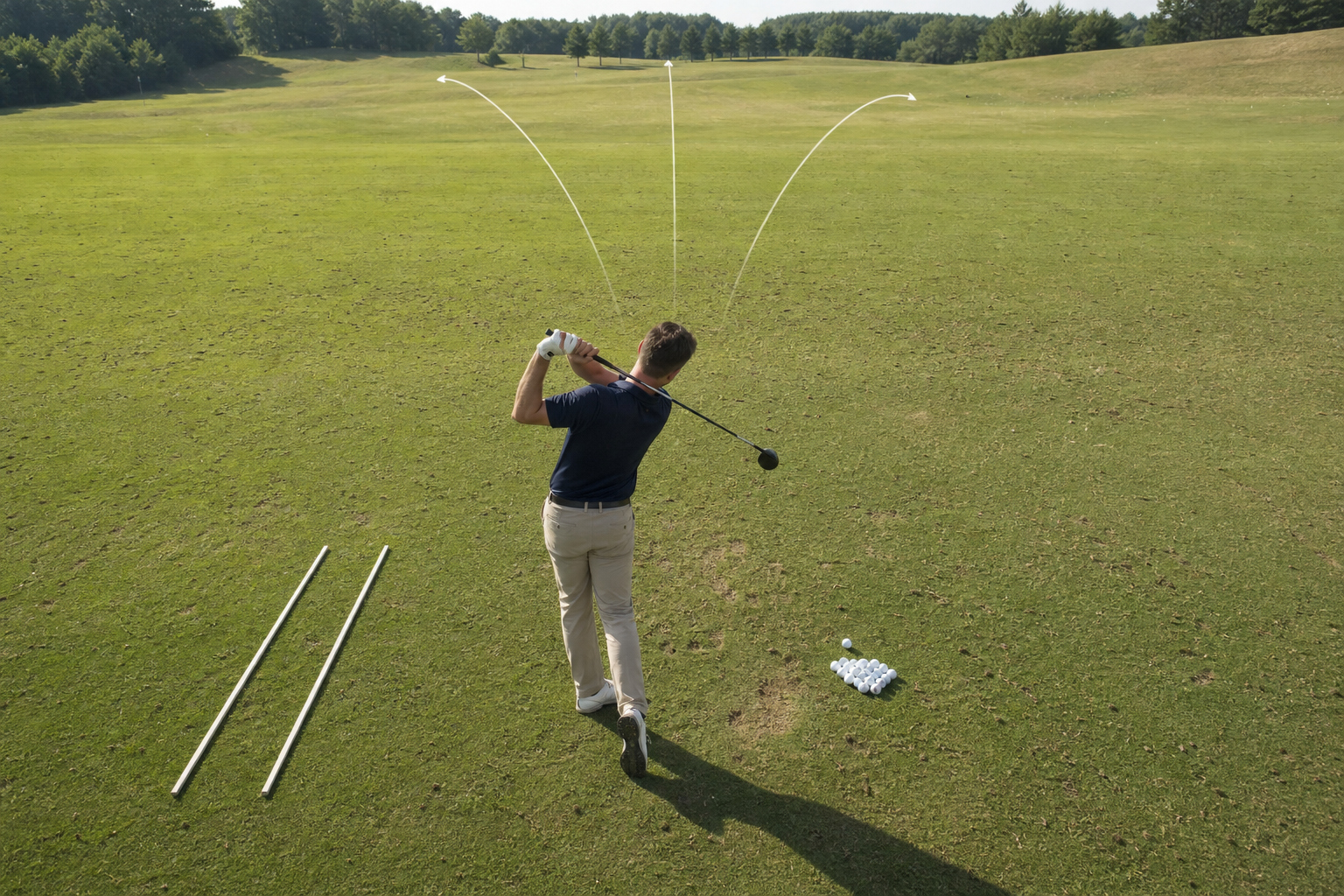
Built for: Golfers choosing between inexpensive practice aids for alignment, movement, rhythm, or speed awareness.
When a range session produces scattered shots, it is tempting to buy the tool that promises the broadest fix. Start smaller. Alignment sticks give you an external reference for setup and intended direction; a swing tempo trainer gives you a repeatable movement cue. The better purchase is the one that lets you observe and work on the problem you actually have.
The quick verdict
Choose alignment sticks when you cannot reliably describe where you aimed, where you started the ball, or how your feet and club related to the target line. Choose a tempo trainer when your setup is clear but your motion feels rushed, stalled, or different from swing to swing.
Best for Alignment sticks suit golfers who need visible ground references and can practice in an area where rods can lie safely on the ground. A tempo trainer suits golfers who will use one simple rhythm cue repeatedly rather than collecting multiple swing thoughts.
Skip it if Skip both for now if you cannot name an observable practice goal. Purposeful practice starts by connecting an activity to a specific goal, so a gadget without a defined question can turn into busywork.
Begin with the shot you can describe
A golfer who says, “I was all over the place,” still has a useful next step: separate the observation. Were you unsure where you were aimed? Did balls begin left or right of the line you had chosen? Or did the setup look settled, while the motion itself alternated between quick and hesitant? Those are different practice problems, and they call for different feedback.
This distinction matters on the course. Picture a player on a short par 3 who picks a flag but never chooses an intermediate spot or a consistent target line. A visible reference on the range can make that pre-shot decision concrete. Now picture another player who aims comfortably at the same spot, then feels one tee shot is hurried and the next is overly careful. That player needs a repeatable pace cue more than another line on the turf.
Guild recommendation: Buy the tool that answers the question you can observe during a session, not the tool with the longest list of claimed benefits.
Alignment sticks: choose external reference feedback
Alignment sticks are most useful when the missing information is outside the golfer: intended direction, a line on the ground, or consistent placement relative to that line. They do not tell you what your swing is doing. They give you a reference you can set, step away from, and check again.
Use them if you routinely finish a shot unsure whether you had aimed where you thought you had. They also fit golfers who enjoy structured stations: select a target, lay down a line, hit a small set of shots, then reset. The observable outcome is modest but valuable: you can say whether your body position and intended line were the same from ball to ball.
They are a poor first choice for a golfer who already has a clear target routine and wants help maintaining a consistent cadence. In that case, adding more rods can create more visual information without addressing the felt difference between swings.
Guild recommendation: Choose alignment sticks when you need to make your intended line visible before the club moves.
Tempo trainers: choose movement-cue feedback
A swing tempo trainer is a better fit when the golfer’s question is about pace: whether the motion feels rushed, interrupted, or inconsistent. Its value is not that it supplies a universal rhythm. Its value is that it gives one repeatable cue for the golfer to compare from swing to swing.
That makes it practical for the player who can stand behind the ball, choose a target, and set up with confidence, yet senses a different pace under pressure. A simple cue may keep a practice session from becoming a search for five mechanical corrections. The observable outcome is whether the golfer can reproduce the same intended pace across a small group of swings.
Skip a tempo trainer if you expect it to settle a target-line question for you. A rhythm cue cannot show where you aimed. It also deserves a safety check: use it only with adequate room, follow its instructions, and avoid treating a practice motion as suitable for every location.
Guild recommendation: Choose a tempo trainer when your direction choice is clear but the pace of your motion is the variable you want to monitor.
Do not turn two aids into one unfocused drill
Owning both tools can be useful, but use them in separate blocks. Start with an alignment-sticks block when the day’s goal is an intended line and ball-start observation. Use a tempo-trainer block when the goal is a repeated movement cue. Combining every reference at once makes it harder to know which feedback changed your attention.
The governing idea is purposeful practice: connect the activity to a specific goal. A six-ball block with one observation is more informative than a large bucket spent changing setup, rhythm, target, and club all at once. Keep a brief note after each block. “Target line was clear, pace varied,” is enough to guide the next session.
Neither aid is a free pass to use training equipment during a competitive round. Equipment and its use in a stipulated round are governed by applicable rules, so check the rules that apply to your event before bringing any aid onto the course.
Guild recommendation: Use one aid per practice question, record one observable result, and check applicable rules before using training equipment in a stipulated round.
Try this · 15 minutes.
The 12-Ball Feedback Split Test
Choose one target and an intermediate spot a few feet ahead of the ball. For the first six balls, place two alignment sticks flat on the ground: one aimed through the intermediate spot and a second parallel to it at your toe line. Leave enough room that neither stick can be struck. For the final six balls, remove the sticks and use a tempo trainer only as directed by its manufacturer, making sure you have clear space around you.
- Before each of the first six shots, stand behind the ball, identify the target and intermediate spot, then step in and make a normal swing. Note only where the ball starts relative to the intended line: left, near it, or right.
- After six shots, write down whether you could set the same intended line each time and how often the ball began near that line. Do not change your swing during this block.
- For the next six shots, use one simple rhythm cue from the tempo trainer or its instruction, then make normal swings toward the same target. Note whether the pace of each motion felt repeatable and where each ball started.
- Compare the two notes. If the ground references made the intended line clearer, prioritize alignment sticks. If your intended line was already clear but the rhythm cue was easier to repeat, prioritize a tempo trainer. If neither result is clear, repeat the same test on another day before buying anything.
What progress looks like: The useful result is a clear answer to one question: did a target-line reference or a rhythm cue make your next six swings easier to describe and repeat?
Put the guide to work
These searches are a starting point—not a substitute for the fit and comparison criteria above.
Compare plain alignment sticks after deciding you need a ground reference.
Compare a pair that is easy to carry with one you are comfortable placing flat on the ground. The practical requirement is a visible, repeatable reference rather than extra features.
Compare simple swing tempo trainers after deciding you need a rhythm cue.
Compare how the trainer delivers its cue and whether its setup suits your available practice space. Favor one clear cue over a complicated routine you will not repeat.
If you buy through these links, Guild of Golf may earn a commission at no extra cost to you.
The practical takeaway
- Alignment sticks provide external, ground-based feedback for golfers who need to clarify an intended target line.
- A tempo trainer provides a repeatable movement cue for golfers whose setup is clear but whose pace changes from swing to swing.
- A short, separated test is more useful than buying both aids on the assumption that more feedback is always better.
- Practice with a specific goal, then judge the aid by whether it makes that goal easier to observe.
- Applicable equipment rules govern what may be used during a stipulated round.
Frequently asked questions
Should a beginner buy alignment sticks or a tempo trainer first?
Start with the aid that addresses the clearest observation. If the beginner cannot consistently identify an intended line, alignment sticks offer a simple ground reference. If the intended line is clear but the motion feels markedly rushed or uneven, a simple tempo cue may be the better first tool.
Can alignment sticks and a tempo trainer be used in the same practice session?
Yes, but use separate blocks with separate goals. For example, use sticks to establish and observe an intended line, then remove them before using a tempo cue to observe whether your movement pace is repeatable.
Will either aid diagnose my swing?
No. These aids provide references or cues. They can help you make an observation more consistent, but they do not diagnose why a particular shot pattern occurs.
Can I use these aids during a tournament round?
Do not assume so. Equipment and its use during a stipulated round are governed by applicable rules, so consult the rules that apply to the competition.
Sources used for this draft
- PGA of America: Practice With Purpose — The principle that purposeful practice connects an activity to a specific goal.
- USGA Equipment Rules — The note that equipment and its use during a stipulated round are governed by applicable rules.
Guild of Golf may earn a commission from qualifying purchases made through Amazon links or searches associated with this article.