
evergreen guide
Choose a Home Launch Monitor by the Shot Problem You Can See
A practical framework for choosing a personal launch monitor by matching one observable ball-flight problem to the measurement and home setup that can make practice measurable.
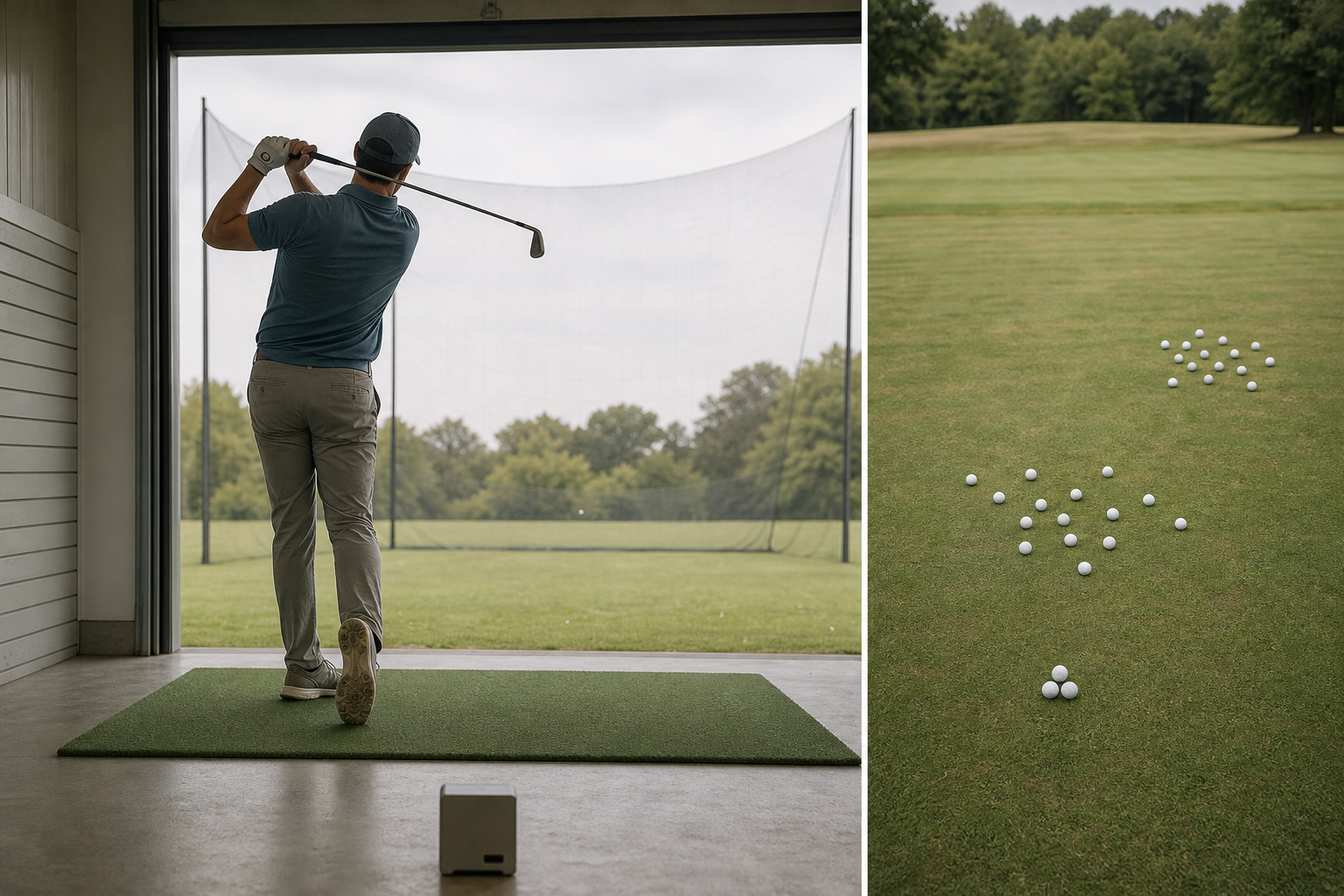
Built for: Golfers deciding whether a personal launch monitor provides the measurements and setup their practice actually needs.
The costly mistake is not choosing the monitor with too few numbers; it is buying one that produces numbers unrelated to the shot you are trying to change. Begin with a repeated, observable result, then require a measurement, practice space, and review routine that can make that result easier to track.
The quick verdict
Choose a home launch monitor only after naming one repeatable shot outcome you want to monitor and confirming that the unit can report a relevant result in the space where you will actually practice.
Best for Golfers who can describe a specific pattern, such as inconsistent distance with one club or a shot that repeatedly finishes short of a target, and who will use a simple repeatable practice routine.
Skip it if Skip the purchase for now if you do not have a safe repeatable hitting area, cannot identify a practice question, or expect a device to diagnose and fix a swing on its own.
Begin with the ball result, not the dashboard.
A golfer who says, “My 7-iron goes nowhere,” has not yet created a useful buying brief. Distance may vary because the shots are scattered, because the player is changing clubs or targets, or because the comparison is based on a few memorable strikes. A better starting point is an observable statement: “Ten shots with my 7-iron repeatedly finish short of my chosen target,” or “My wedges produce an unpredictable long-short pattern.” That statement gives the monitor a job. Practice with a defined purpose and measurable structure is the useful standard, rather than collecting numbers merely because they are available.
Guild recommendation: Write one sentence describing the result you see before comparing a single monitor feature.
Match one question to one reported result.
For a distance-control question, prioritize whether the unit reports a consistent distance result you can log from session to session. For a starting-direction question, prioritize a result that helps you compare where shots begin relative to the target. For a trajectory question, look for a clearly described trajectory-related output and a way to review it after several shots. Do not assume a longer feature list is better. A golfer practicing half swings in a garage may gain more from one dependable session record than from a crowded screen of unfamiliar labels.
Guild recommendation: Make a short must-have list with one primary reported result, one optional result, and no other required metrics.
Treat the home setup as part of the product.
The useful question is not whether a launch monitor is portable in the abstract; it is whether your intended practice station can be recreated. Measure the hitting area, decide where the ball, target, and monitor would sit, and account for safe clearance around the swing. Then consider the workflow: Can you set the unit up, see the result, and record a 10-shot session without rearranging the room? A unit that requires more space, placement precision, or screen interaction than your routine allows can turn purposeful practice into occasional entertainment.
Guild recommendation: Sketch your intended hitting station and reject options whose documented placement or operating requirements do not fit it.
Ask for support behind the claim.
A launch monitor’s numbers should not be accepted as self-explanatory. Read the seller’s and manufacturer’s documentation for what each output means, the conditions under which it is intended to operate, and any stated limitations. Compare like with like: the same club, target, ball type, and practice location across sessions. The Federal Trade Commission’s advertising guidance emphasizes that objective product claims need a reasonable basis; that is a sound buyer’s habit as well. Look for a clear explanation of what is being claimed instead of relying on a vague promise of improved performance.
Guild recommendation: Favor products with plain documentation about their reported outputs, setup requirements, and supported practice environment.
Use trends, not a hero shot.
A personal monitor earns its place when it makes the next practice decision simpler. Suppose 10 controlled 8-iron shots repeatedly produce a similar distance result but land left of the chosen target. Your next session can retain the same club and target while tracking the left-right pattern. If the distance results vary widely, the first task may simply be establishing a more stable baseline with the same setup. Neither pattern identifies a swing cause, and neither requires an immediate equipment change. The point is to turn an on-course frustration into a record you can revisit.
Guild recommendation: Review groups of shots under the same conditions and base your next session on the pattern, not the best individual result.
Try this · Twenty minutes.
The One-Club Baseline Session.
Use a safe legal practice area, one club, one consistent ball type, and one target or landing reference. If you use a launch monitor, place and operate it according to its instructions. Choose a target distance or target area that fits the available space and use the same setup for every shot.
- Write one neutral question before hitting, such as, “How consistent is the distance result I receive with this club today?”
- Make five easy warm-up swings or shots without recording a judgment about them.
- Hit 10 shots with the same club and the same intended target. After each shot, record only the result the device reports that answers your question, or record whether the ball finished short, long, left, right, or near your target when no device result is available.
- Circle the three results that best represent the session rather than reacting to the single best or worst shot.
- For the final five shots, keep the same target and try to reproduce the session’s most useful reference result. Do not add a mechanical change during the session.
What progress looks like: The session is successful when you finish with a clear baseline, such as a repeatable distance range or a plainly recorded short-long pattern, that you can compare with the next session.
Put the guide to work
These searches are a starting point—not a substitute for the fit and comparison criteria above.
Search personal launch monitors by reported measurements.
Compare the reported measurements with the one result in your baseline session that you intend to track, then check the documentation for the required setup and operating conditions.
Search home golf practice nets for your available space.
A monitor is useful only in a practice area where you can safely repeat the same club, target, and setup often enough to compare sessions.
If you buy through these links, Guild of Golf may earn a commission at no extra cost to you.
The practical takeaway
- A home launch monitor should answer a practice question you can state in observable terms.
- The best feature is the one that tracks your chosen result, not necessarily the longest list of reported metrics.
- Safe space, repeatable placement, and a low-friction routine determine whether the monitor becomes part of regular practice.
- Use comparable 10-shot sessions to identify trends without treating a device as a swing diagnosis.
- Read product documentation closely and seek clear support for objective performance claims.
Frequently asked questions
What is the first feature to compare in a home launch monitor?
Compare the reported result that directly addresses your main practice question, such as a repeatable distance result for a distance-control baseline.
Do I need every available measurement for useful practice?
No. A focused practice session can be more useful when it tracks one clearly defined result under repeatable conditions.
How can I tell whether my home space is suitable?
Plan the safe hitting area, target, ball position, monitor position, and room for a full swing before buying, then compare that plan with each product’s documented setup requirements.
Can a launch monitor tell me how to fix my swing?
A monitor can help you record ball or shot results, but it does not replace a clear practice plan or establish the cause of a swing pattern.
How should I judge whether a monitor is helping?
Judge it by whether you can complete the same short session repeatedly and use its results to describe a clearer pattern at the end of practice.
Sources used for this draft
- PGA of America: Practice With Purpose — The recommendation to give practice a defined purpose and measurable structure.
- FTC Advertising and Marketing Basics — The recommendation to seek a reasonable basis and clear support for objective product claims.
Guild of Golf may earn a commission from qualifying purchases made through shopping links, at no additional cost to the buyer.