
comparison
Putting Mirror vs. Mat: Buy for the Problem You Can Measure.
Choose a putting mirror when your recurring issue is an observable setup question, and choose a putting mat when you need repeatable evidence about starts and finishes at home.
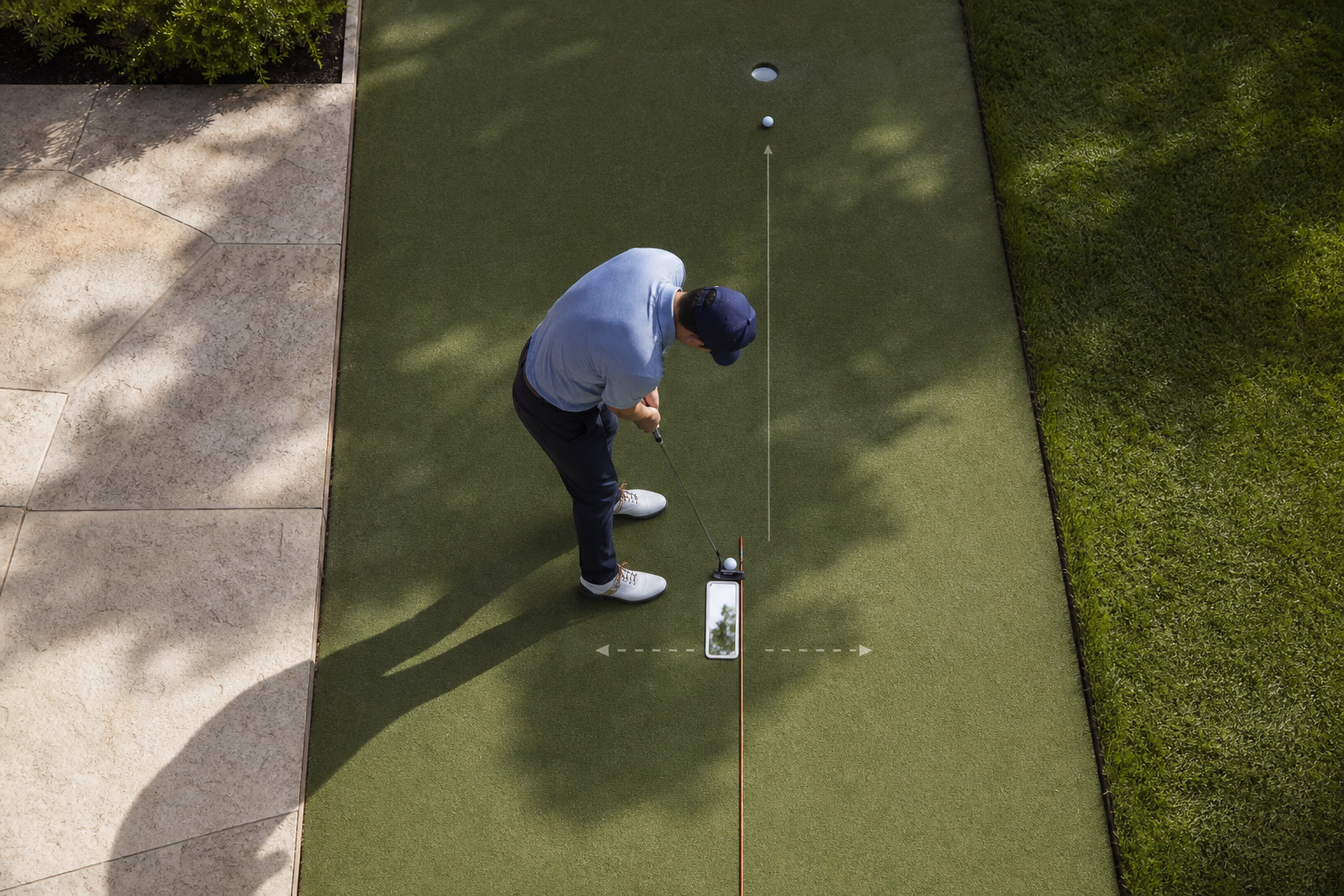
Built for: Golfers choosing one practice aid and deciding whether they need setup feedback or ball-roll feedback.
A short putt can miss for many reasons, but a home practice tool should answer one visible question at a time. Begin with the result you can observe: uncertainty over how you address the ball, or uncertainty over whether your putts repeatedly start and finish where intended.
The quick verdict
Buy a putting mirror when you need to check a specific address position before each repetition; buy a putting mat when your priority is repeating a short-putt task and recording the outcome. If only one tool fits the budget, choose the one that makes your current miss easier to observe rather than the one with the longest feature list.
Best for A mirror is best for the golfer who repeatedly wonders whether their eyes, putter, or ball are set up the same way. A mat is best for the golfer who can establish an address comfortably but needs a consistent indoor task for tracking starts and finishes.
Skip it if Skip a mirror if visual setup checks make you second-guess every stroke. Skip a mat if you do not have a flat, clear area long enough to set it out and you will not use a portable surface regularly.
Start with the miss that remains visible.
The familiar home-practice trap is buying a mirror because alignment sounds important, then discovering that the real frustration is missing the same four-foot target three different ways. The reverse happens, too: a golfer rolls ball after ball on a mat but never resolves the nagging sense that each ball begins from a different address. Practice has more value when it has a defined purpose and structure, so give the purchase a narrow job before comparing features. Ask what you can observe without guessing: an inconsistent address picture, or inconsistent results on the same short task.
Guild recommendation: Write down one recent short-putt pattern before buying. “I cannot tell if I address the ball the same way” points toward a mirror; “my results vary on the same indoor putt” points toward a mat.
Choose a mirror for an address question.
A putting mirror earns its place when the uncertainty occurs before the ball moves. For example, a golfer may feel comfortable on a practice green but, at home, keep shifting closer to or farther from the ball without noticing. A reflective surface can make an address reference visible, allowing the golfer to set up, check one chosen relationship, and then make the putt. The constraint is discipline: its value falls quickly if every reflection becomes a reason to rebuild the setup. A compact, stable mirror with enough viewing area for the single reference you want is more useful than a complicated layout you will not revisit.
Guild recommendation: Choose a mirror if you can name the pre-putt question you want to answer in one sentence. Use one check per putt, then direct attention back to the target.
Choose a mat for a repeatable outcome question.
A putting mat is the better fit when you need a dependable home station for repeating the same distance and target. Think of the golfer who says, “I start the session well, but I do not know whether I am becoming more consistent.” A mat can establish the same roll-out task often enough that makes, finishes, and misses can be recorded instead of remembered selectively. The tradeoff is space and surface commitment. Before choosing one, measure the clear floor area you can leave available, decide the short-putt distance you will actually practice, and check whether the mat will sit securely where you plan to use it.
Guild recommendation: Choose a mat if you will repeat one defined target task at least twice a week and can record a simple result, such as putts finished at the target out of 12.
Do not make one tool answer both questions.
A mirror and a mat can complement each other, but the first purchase should remove the biggest uncertainty. If you buy a mirror to solve outcomes, you may spend the session staring at setup while never measuring whether the ball finishes where intended. If you buy a mat to solve an address concern, you may accumulate makes without knowing whether your starting picture is changing. Golf’s putting rules provide the on-course context for putting greens and lines of play, while home practice is most productive when its purpose is clear. Let the aid supply feedback on one controllable part of the routine, not a verdict on your putting stroke.
Guild recommendation: Use the 12-putt evidence check before adding a second aid. Buy the second tool only when the first has made its own question clear and a different observable question remains.
Compare the feature that preserves your routine.
Once you know the job, shopping becomes simpler. For a mirror, compare stability, usable reflection area, portability, and whether its markings or guides are simple enough to support your single check. For a mat, compare available length in your room, secure placement on your floor, a clear finish target, and storage demands. Avoid treating extra guides, targets, or accessories as automatic value. The best feature is the one you can use without stretching your room, delaying your routine, or turning a ten-minute session into equipment adjustment.
Guild recommendation: Keep the first home station deliberately plain: one target, one distance, one observation, and a brief note after each set.
Try this · 10 minutes.
The 12-Putt Evidence Check.
Choose a level-looking indoor area and a target about 4 to 6 feet away. Use six balls or repeat two balls, and place a small object behind the ball position as a reference. If using a mirror, place it so it allows a simple view of your address; if using a mat, use its target or make a small target at the far end.
- Hit six putts without changing your routine, and note only two observations: whether the ball appears to begin on your intended route and whether it finishes at the target.
- If your address looks different from putt to putt or you cannot tell where your eyes and putter are relative to the ball, use a mirror for the next six putts. Make one deliberate setup check, then look at the target and putt.
- If your setup already feels repeatable but the first six putts vary in start or finish, use a mat for the next six. Keep the same target distance and record how many finish at the target.
- Do not alter several things at once. Repeat the same six-putt task on another day and compare the simple totals.
What progress looks like: A useful result is not a perfect score; it is a clearer answer about whether the inconsistency you can observe occurs before the stroke at address or during the repeated roll-to-target task.
Put the guide to work
These searches are a starting point—not a substitute for the fit and comparison criteria above.
Compare putting mirrors.
Compare viewing area, a stable non-slip base, and whether the layout lets you check one address reference without crowding the ball.
Compare indoor putting mats.
Compare the usable straight-putt length, how securely the mat lies on your floor, and whether its target gives you a repeatable finish point.
If you buy through these links, Guild of Golf may earn a commission at no extra cost to you.
The practical takeaway
- A putting mirror is an address-feedback tool when your visible problem occurs before the ball moves.
- A putting mat is an outcome-feedback tool when you need to repeat and record the same short-putt task.
- Choose one feature that answers one observable question, rather than buying a broad collection of practice prompts.
- A useful practice session has a stated purpose, a repeatable setup, and a simple success signal.
Frequently asked questions
Should a beginner buy a putting mirror or a putting mat first?
Start with the tool that answers the beginner’s clearest visible question. Choose a mirror when establishing a consistent address is the obstacle, and choose a mat when the golfer needs a straightforward, repeatable target task at home.
Can I practice with a putting mirror without a mat?
Yes. Use a clear, level-looking patch of floor or another safe practice area, make one address check, and keep the target task simple. The mirror’s job is to make the chosen setup reference visible, not to create a long practice session by itself.
Can a putting mat replace practice on a putting green?
No home tool duplicates every on-course putting situation. A mat is most useful as a structured place to repeat one short-putt task, while the rules context for putting greens and lines of play belongs on the course.
What should I track during home putting practice?
Track one outcome that matches your purpose, such as the number of putts that finish at the target in a set of 12. If you use a mirror, also note whether you completed the same single address check before each putt.
Sources used for this draft
- PGA of America: Practice With Purpose — The guidance that practice is more useful with a defined purpose and structure.
- USGA Rule 13: Putting Greens — The rules context for putting greens and lines of play.
Guild of Golf may earn a commission from qualifying purchases made through the shopping searches above, at no additional cost to you.