
comparison
Putting Mirror vs. Mat: Choose the Feedback Behind Your Miss
A purposeful guide to choosing a putting mirror or putting mat by starting with the observable problem in your home practice.
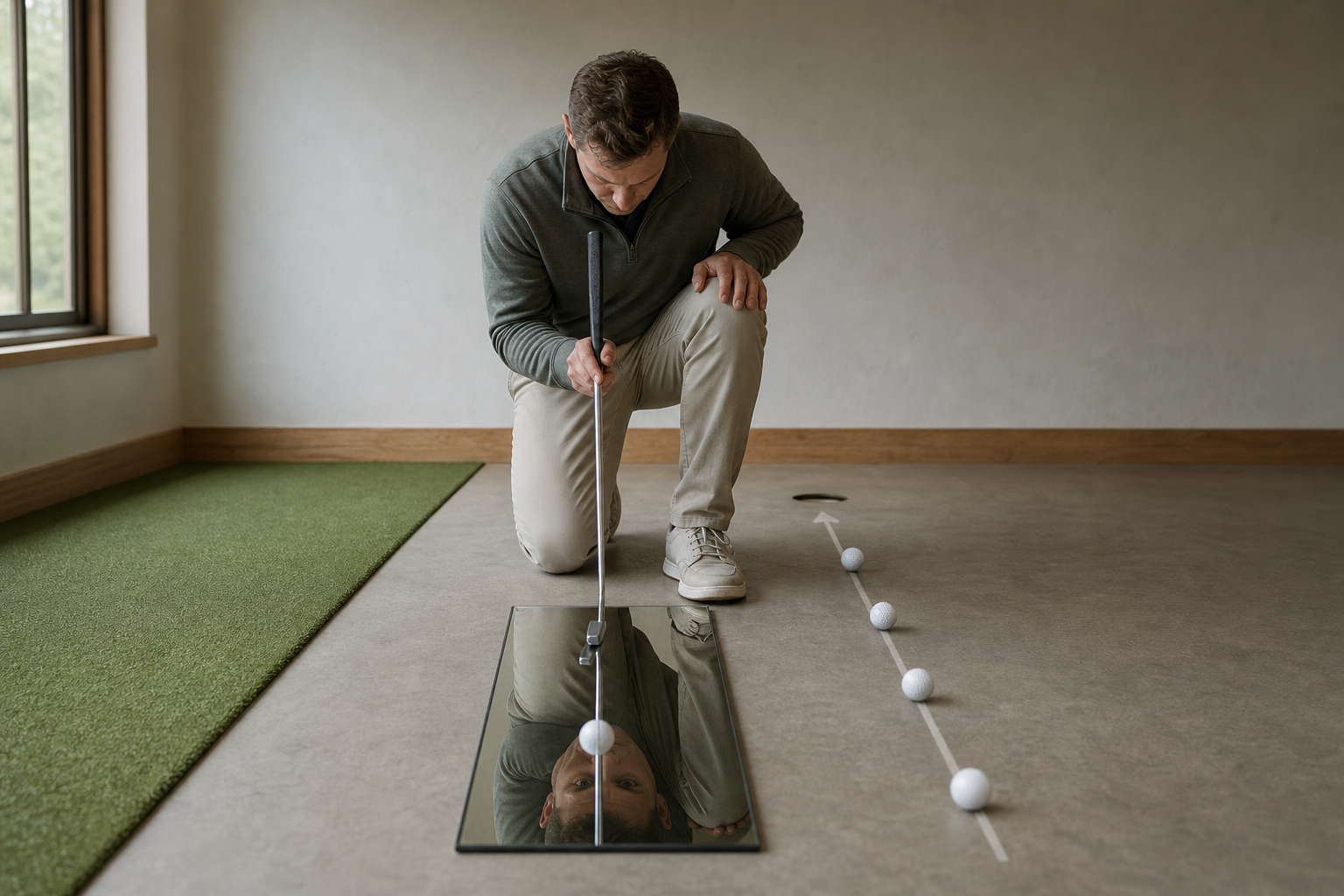
Built for: Golfers choosing one practice aid and deciding whether they need setup feedback or ball-roll feedback.
When a three-foot putt keeps starting left, missing the cup, or feeling different every session, buying both aids can hide the question that matters. Choose the single tool that gives feedback on the part of the miss you can observe: your address picture or the ball’s journey to the target.
The quick verdict
Buy a putting mirror when the visible question is whether your eyes, face, or body are aimed consistently at address. Buy a putting mat when the visible question is whether a ball repeatedly starts and rolls toward a defined target. Do not expect either tool alone to explain every missed putt.
Best for A mirror is best for golfers who cannot settle into a repeatable address picture; a mat is best for golfers who need a contained target and repeatable start-line practice at home.
Skip it if Skip a mirror if you will not pause to inspect the reflection before each putt. Skip a mat if you lack enough clear floor space to make the same putt repeatedly.
Begin with what the ball or setup is telling you
A home putting session often becomes unhelpful in a familiar way: the golfer rolls ten balls, changes the stroke thought after every miss, then wonders which purchase will make practice more productive. Start earlier than the stroke. Identify the observable problem. If you stand over the ball and the putter face, eye position, or body picture seems to vary from rep to rep, your first need is setup feedback. If your setup feels settled but you need a defined lane and target to judge whether the ball begins where intended, your first need is ball-roll feedback. Purposeful practice has a defined purpose and structure, so one clear question is more useful than a pile of undirected repetitions.
Guild recommendation: Choose the aid that answers one question you can watch during the session, not the aid that promises to cover every putting problem.
Choose a mirror for an address-picture problem
A putting mirror makes the address position visible. That is useful for the golfer who regularly backs away, resets their feet, or feels uncertain whether their eyes and putter are in the same place from one three-footer to the next. The value is immediate: pause before the stroke, look at the reflection, and decide whether the picture matches the one you intend to repeat. For example, a player who aims a hallway putt differently every few balls can use the mirror to reduce that uncertainty before worrying about the result. The tradeoff is that reflection is not ball-roll feedback. A mirror can help make the starting position more repeatable, but it cannot by itself show whether every putt traveled toward a target.
Guild recommendation: Buy a mirror first when the miss begins with visible indecision or inconsistency before the putter moves.
Choose a mat for a start-line and repetition problem
A putting mat gives a golfer a contained practice lane and a recurring target. It suits the player whose useful question is simple: did the ball begin toward the intended spot, and can that happen again? Consider the golfer who has a small corner of a room and wants to roll the same short putt each evening. A mat can make that repetition easier to organize because the target and lane are already defined. Its limitation is equally important. A mat may reveal a pattern in the ball’s route, yet it does not show the golfer what their eyes or putter face looked like at address. Treat the observed roll as feedback, not as proof of one particular cause.
Guild recommendation: Buy a mat first when you have reliable floor space and will use a clear target to track whether the ball starts where you intend.
Avoid buying features that do not answer your question
Before searching, decide how the aid will fit into a real session. For a mirror, assess whether you can see a clear reflection from your normal address position and whether the footprint works on your chosen floor area. For a mat, measure the clear space you can leave available or set up easily, then consider whether its target gives you a repeatable task rather than an excuse to hit putts without attention. Do not let a long feature list replace that decision. A compact mirror that you use for five attentive setup checks can be more useful than a larger aid left in a cupboard. Likewise, a simple mat with a target you can reach consistently can be more useful than a more elaborate option that is inconvenient to store.
Guild recommendation: Compare fit, visibility, target clarity, and setup friction before browsing the focused searches above.
Carry the lesson back to the course
Home practice is a place to rehearse a clear observation, not to assume that every indoor result transfers unchanged to a putting green. Rule 13 provides the rules context for putting greens and lines of play in actual play. On the course, read the putt and follow the applicable rules; at home, use your chosen aid to make your setup check or start-line task more deliberate. The useful transfer is the routine: identify the target, settle into a repeatable address picture, and make one committed stroke.
Guild recommendation: Use the same brief pre-putt check from home on short on-course putts, while allowing the green and the situation to determine the actual line.
Try this · 12 minutes.
The One-Question Putting Session
Create one short, straight practice lane on a flat, clear indoor surface with a coin or other small safe object as the target. Use either a putting mirror or a putting mat, not both, and use the same ball and putter throughout the session.
- First, name one observable question before you hit a ball: “Can I see a repeatable address picture?” for a mirror, or “Can I start the ball toward this target?” for a mat.
- Hit five putts without changing the target. With a mirror, pause at address and note whether the reflected picture looks the same before each stroke. With a mat, watch whether each ball begins on the intended route toward the target.
- Take a short break, then repeat five putts while keeping the same single question. Do not add a new mechanical cue mid-session.
- Finish with two putts in which you simply recreate the best repeatable setup or start line you observed, rather than trying to force a result.
What progress looks like: The session succeeds when you can state one specific, repeatable observation—either that your address picture matched more often or that more balls began toward the target—without guessing at a hidden swing cause.
Put the guide to work
These searches are a starting point—not a substitute for the fit and comparison criteria above.
Compare putting mirrors
Compare the usable reflective area, whether the viewing position suits your setup, and whether the format fits the place where you will actually practice.
Compare putting mats
Compare the mat’s usable length, target design, and storage footprint so you can repeat the same putt without turning setup into a chore.
If you buy through these links, Guild of Golf may earn a commission at no extra cost to you.
The practical takeaway
- A putting mirror answers a setup-picture question, while a putting mat answers a repeatable ball-roll question.
- Choose one observable problem before you buy, so each practice session has a defined purpose.
- A mat does not diagnose setup, and a mirror does not replace a target-based ball-roll task.
- The best home aid is the one that fits your space and is simple enough to use repeatedly with attention.
Frequently asked questions
Should a beginner buy a putting mirror or a putting mat first?
Choose the one that makes the beginner’s first practice question easier to observe. A mirror suits uncertainty about repeatable address; a mat suits a need for a consistent target and ball-roll task.
Can a putting mirror fix a putt that starts offline?
A mirror can provide visible setup feedback, but it cannot establish the cause of an offline start. Use it to make the address picture more repeatable and observe ball direction separately when possible.
Does a putting mat simulate every putting green?
A mat provides a repeatable home-practice surface and target task, not a substitute for reading and playing a real putting green. Actual putting-green play has its own rules context under Rule 13.
Is it better to buy both aids?
Only after you can explain what the first aid did not answer. Start with the constraint you can observe, then add the other tool if it addresses a separate, recurring practice question.
Sources used for this draft
- PGA of America: Practice With Purpose — The recommendation to give each session a defined purpose and structure.
- USGA Rule 13: Putting Greens — The rules context for putting greens and lines of play during actual play.
Guild of Golf may earn a commission from qualifying purchases made through Amazon links or searches, at no additional cost to the reader.