
comparison
Putting Mirror vs. Mat: Match One Feature to the Putt You Miss
Choose a putting mirror or putting mat by starting with the observable problem in your putting practice, then buy only the feedback that can address it.
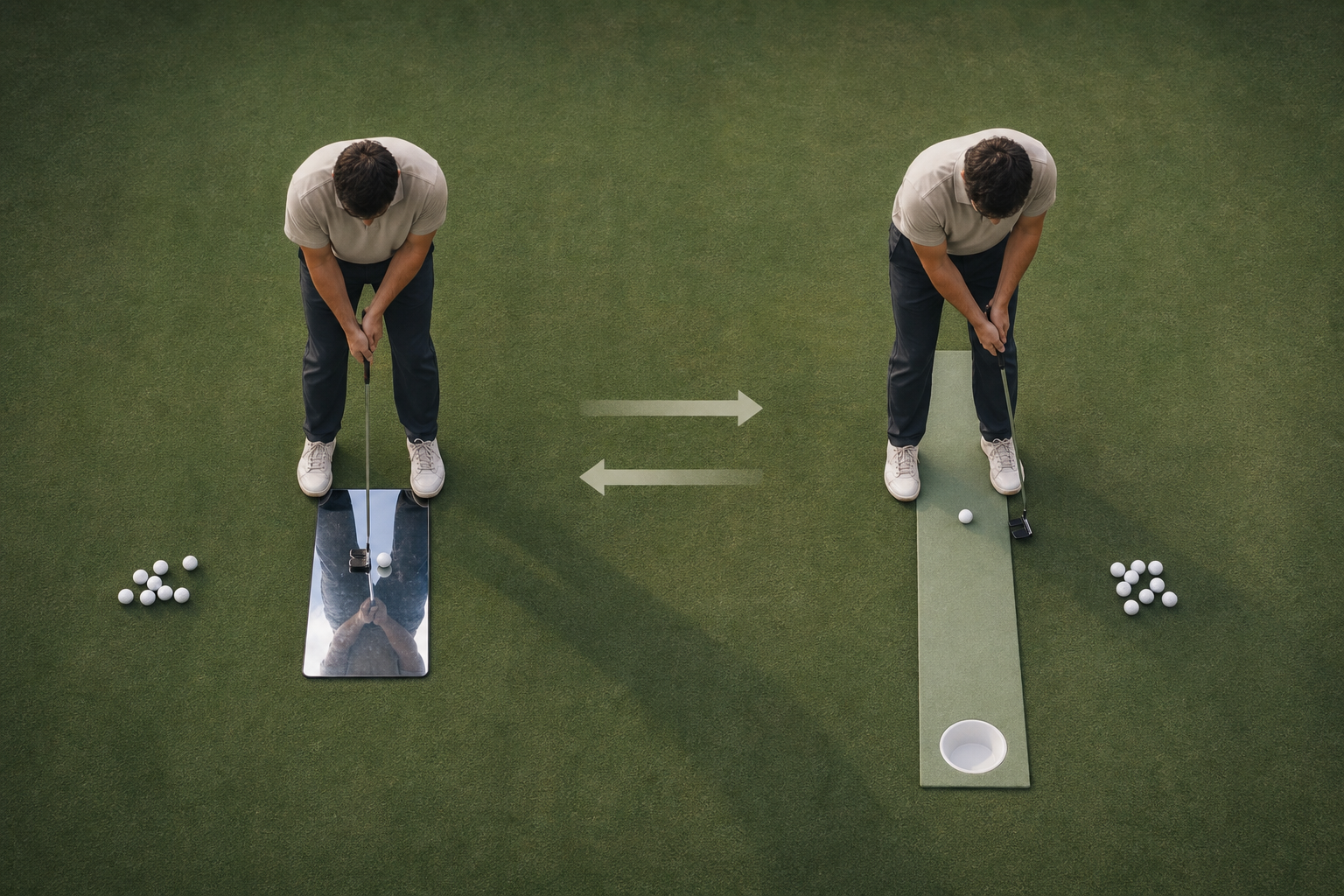
Built for: Golfers choosing one home putting aid and deciding whether they need setup feedback or ball-roll feedback.
A mirror is for checking what your body and putter are doing before impact. A mat is for repeating a start line and judging the result after the ball leaves the face. The better first purchase is the one that makes your most visible practice problem easier to observe.
The quick verdict
Buy a putting mirror when your uncertainty is at address, such as inconsistent eye position, aim, or putter setup; choose a putting mat when you can set up comfortably but need a repeatable target and a clearer record of whether putts start on line.
Best for A mirror best serves golfers who frequently reset their feet, head, or putter behind the ball. A mat best serves golfers who will practice short, repeatable putts in a defined indoor space and record makes, misses, and start-line patterns.
Skip it if Skip the mirror if reflection will prompt constant pose-checking instead of a stroke. Skip the mat if its available length or layout does not allow you to create a simple, repeatable target task.
Begin with the putt you can describe, not the aid you have seen online.
The familiar home-practice trap is rolling twenty putts, watching a few fall, and learning almost nothing that transfers to the next four-footer. Start instead with an observable sentence. “I keep moving my head and resetting before I pull the trigger” is a setup problem. “My address feels settled, but the ball repeatedly starts left or right of a three-foot target” is a ball-result problem. Defined purpose and structure make practice more useful, which is why this choice should begin with the evidence you can see rather than a promise of a universal fix.
Guild recommendation: Choose one observable problem for the next two weeks, and select the aid that lets you see that problem on every repetition.
Choose a mirror when the uncertainty happens before the stroke.
A putting mirror earns its place when the golfer needs a consistent address reference. Picture the player who stands over a short putt, shuffles the feet twice, raises the head to check the line, then makes a guarded stroke. The mirror can make the pre-stroke picture visible: where the eyes appear relative to the ball, how the putter is aimed at address, and whether the golfer returns to a similar stance. That is useful feedback for a player who cannot tell why every setup feels slightly different. Its limitation is equally important. A mirror does not make the ball’s journey to a target the center of the task, so it can encourage too much checking if every putt becomes a search for perfect positions.
Guild recommendation: Buy a mirror first if a consistent, calm address picture is the missing ingredient; skip it if you already set up decisively and need more evidence from the rolling ball.
Choose a mat when the uncertainty begins after impact.
A putting mat is the more direct choice when your practice needs a fixed target, repeated distance, and an easy record of outcomes. Consider the golfer who says, “That felt solid,” but cannot say whether the ball began on the chosen line or whether the pace was repeatable. A home surface creates the same lane for each attempt, so a session can have a measurable task: send 10 balls toward a target from the same spot and count the starts that finish in the target zone. It is particularly useful when a busy evening leaves time for a compact, repeatable routine. The tradeoff is that the surface cannot show whether a poor result began with an inconsistent setup, and a mat that does not lie flat or fit the available room will not support reliable repetition.
Guild recommendation: Buy a mat first if you will use a fixed target and record a simple result; skip it if your space prevents a flat, repeatable setup or you are still unsure where you are aiming at address.
Make the feature serve the task, then let the course remain the test.
Neither tool replaces putting on the course, where the conditions on a putting green and the line of play matter under Rule 13. Home practice has a narrower job: make one part of the routine observable enough to repeat with intention. Use a mirror session to establish one address reference, then roll a handful of balls to a small target without staring at the reflection. Use a mat session to collect start-line results, then resist explaining every miss with a mechanical change. If your notes show a stable address but scattered starts, the mat is offering useful information. If you never feel settled enough to begin the stroke the same way, the mirror has the clearer role.
Guild recommendation: Keep the practice task small enough to measure, and judge whether it helps you arrive on the course with a clearer routine rather than a longer list of thoughts.
Try this · 10 minutes.
The Five-Putt Evidence Check
On a level, clear indoor surface, place a ball and a small target such as a cup, coin, or taped mark about three to five feet away. If using a mirror, place it under the ball only if it sits flat and leaves a clear, safe putting area. If using a mat, use its intended target or place the same small target at the end. Use one ball at a time and the same putter throughout.
- Hit five putts with the sole aim of starting the ball toward the target, without changing your setup between strokes.
- If using a mirror, pause before each stroke and note one visible item only: whether your eyes, putter face, or body position appears consistent from putt to putt. Do not try to correct several items at once.
- If using a mat, note whether each ball begins toward the intended target and whether it reaches the target zone with a similar pace. Do not alter the surface or target between putts.
- Repeat one more set of five, making just one deliberate change based on the feedback you chose to observe, such as returning to the same address picture or using the same finish distance.
- Write down the number of putts that started toward the target in each set, plus one brief observation about the feedback that was easiest to use.
What progress looks like: The useful result is not a perfect make total; it is a clearer, repeatable pattern, such as eight of 10 balls starting toward the target or one setup picture you can reproduce without repeated resetting.
Put the guide to work
These searches are a starting point—not a substitute for the fit and comparison criteria above.
Compare putting mirrors after deciding you need address feedback.
Compare the usable reflective area, whether the surface lies flat, and whether its markings help you check one setup reference without crowding your stroke.
Compare putting mats after deciding you need repeatable ball-roll tasks.
Compare the available straight-putt length, the target layout, and whether the mat fits flat in the space where you will actually practice.
If you buy through these links, Guild of Golf may earn a commission at no extra cost to you.
The practical takeaway
- A putting mirror supplies pre-stroke setup feedback, while a putting mat makes the ball’s target task easier to repeat and record.
- The best first aid addresses one observable issue, not every possible putting fault.
- Use a mirror for a repeatable address reference and a mat for a repeatable start-line and pace task.
- A five-putt record is more useful than a long, unstructured session because it reveals a pattern you can compare.
Frequently asked questions
Can a beginner choose a putting mirror or mat without knowing a putting diagnosis?
Yes. A diagnosis is not required. Choose based on what you can observe: repeated uncertainty while taking your address points toward a mirror, while a desire to practice the same short putt to the same target points toward a mat.
Is a putting mirror better than a mat for alignment?
A mirror is the more direct tool for observing your address alignment and setup picture. A mat is more useful for seeing whether a ball repeatedly begins toward a fixed target after the stroke.
Can I use both tools in one practice session?
Yes, but give each a separate job. Use a few mirror-assisted rehearsals to establish one address reference, then putt to a target and record the ball result. Avoid trying to inspect every detail during every stroke.
What should I compare before buying a home putting aid?
For a mirror, compare whether it lies flat, gives a usable view, and provides only the references you will use. For a mat, compare whether it fits your room flat, supplies enough length for your chosen task, and gives you a clear target to measure against.
Sources used for this draft
- PGA of America: Practice With Purpose — The recommendation to use a defined, structured practice task.
- USGA Rule 13: Putting Greens — The rules context for putting greens and lines of play.
Guild of Golf may earn a commission from qualifying purchases made through shopping links, at no additional cost to the reader.