
evergreen guide
Choose a More Playable Driver From Your Strike Pattern, Not Its Label
A practical framework for choosing a game-improvement driver by identifying where you strike the face, where the ball finishes, and which miss still leaves a useful next shot.
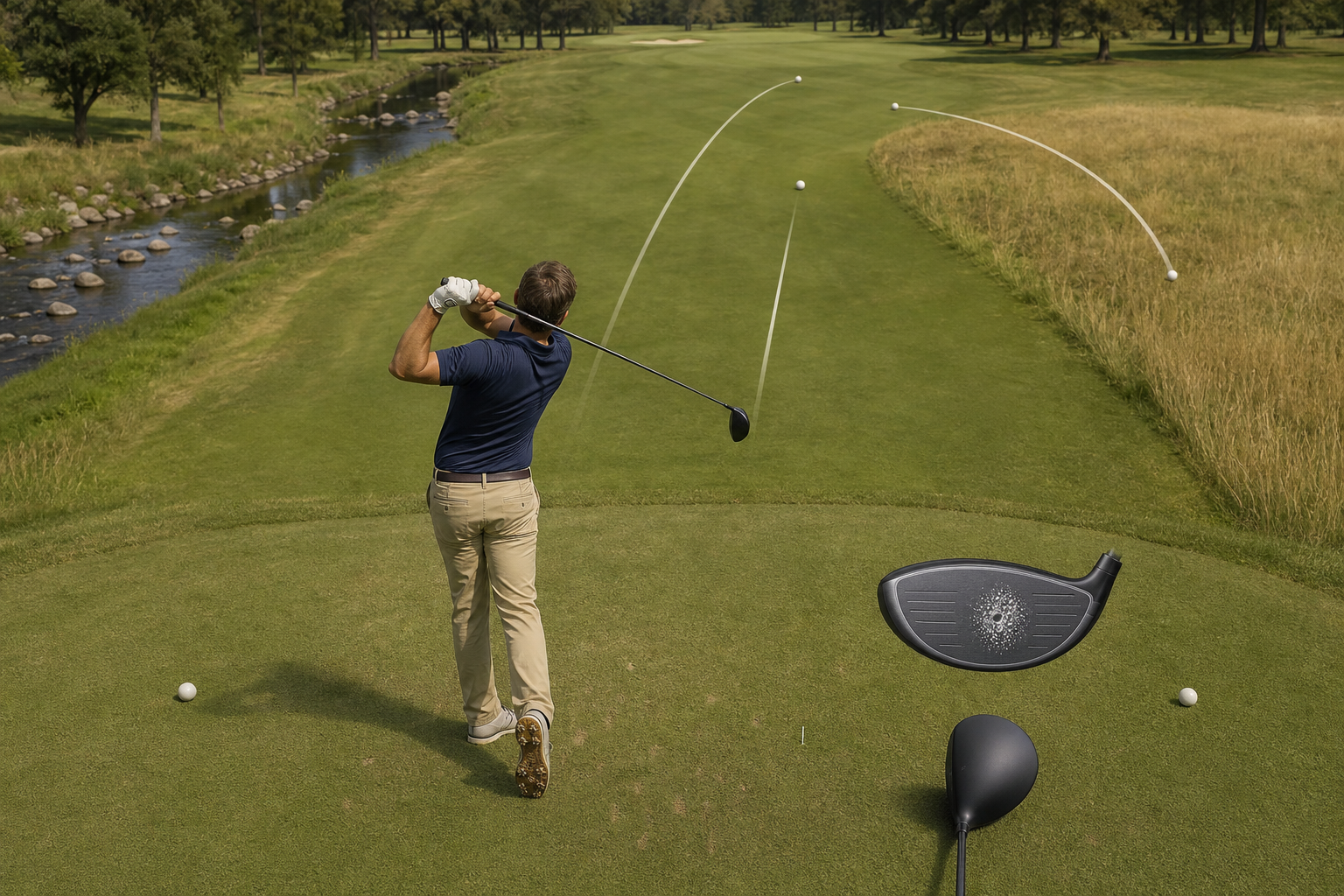
Built for: Golfers seeking a more playable driver who want to evaluate strike consistency, dispersion, launch, and confidence without relying on a vague game-improvement label.
The tee shot that ruins a hole is rarely an abstract lack of forgiveness. It is the heel strike that starts toward trouble, the ball that launches too low to carry a hazard, or the towering miss that leaves no clear second shot. Start with that repeatable result, then compare only the driver feature and fitting option that improves it measurably.
The quick verdict
Do not buy a driver because it wears a game-improvement label. Choose the head, settings, and shaft combination that tightens your usual strike pattern or makes your common miss finish in a more playable place.
Best for Golfers who can describe their typical contact, starting line, curve, launch window, and the on-course consequence of a poor drive.
Skip it if Skip a purchase for now if your results vary so widely that no miss appears more often than another; gather a small sample of drives or work with a fitter before assigning the problem to the club.
The label cannot tell you what your bad drive does
“Game-improvement” is a shopping shortcut, not a diagnosis. Two golfers may both want a more playable driver while needing entirely different things. One loses balls when a shot begins right and keeps moving right. Another makes acceptable starts but catches the ball low on the face and cannot carry a bunker. A third has enough height but alternates heel and toe contact so dramatically that a single attractive drive says very little.
Start by naming the shot that shows up when the hole matters. Where did the ball strike the face? Did it begin left, at the target, or right? Which direction did it curve? Did it finish in fairway, first cut, trees, a penalty area, or simply too short? Those observations create a decision brief that is more useful than a handicap or a marketing category.
Guild recommendation: Write one sentence that connects a recurring tee-shot result to its on-course cost before comparing any driver.
Choose the feature category that matches the observable problem
A driver choice should solve one primary problem first. If your main issue is a repeatable directional finish, compare neutral and directional-bias head options under the same conditions. The winning option is the one that makes the finish more playable, not necessarily the one that produces the single straightest ball.
If launch is the issue, compare loft and adjustable-loft options while watching the height and carry outcome you need on the course. The relevant result is whether a normal strike now reaches the safe side of a hazard or holds its line into a usable landing area. If the issue is scattered contact, evaluate stability-oriented designs by looking for a smaller spread of ball finishes across a group of ordinary swings. Do not make a major purchase because one toe or heel strike looked surprisingly good.
These categories can overlap, but chasing every possible adjustment at once makes the comparison noisy. Pick the characteristic tied to the most expensive miss, then ask whether it changes that result.
Guild recommendation: Match directional options to a repeated directional finish, launch options to an observed carry problem, and stability-focused options to a broadly scattered contact pattern.
Define a playable miss before you look for more distance
A playable miss leaves a next shot. That definition changes with the hole. On a hole guarded by trouble down the right, a modest miss into left rough may be a sensible trade if it avoids the penalty area. On a narrow hole with trees on both sides, the better choice may be the setup that reduces the overall width of your dispersion, even if it does not produce the longest outlier.
Think in landing zones rather than perfect center lines. During a comparison, count how many balls finish in the fairway or in rough from which you could advance the ball. Separately count balls that would create a penalty, blocked recovery, or forced layup. A driver that moves a few balls from catastrophe to rough can be a better course tool than one that occasionally adds distance while retaining the same severe miss.
Confidence belongs in this process too, but make it observable. If a head or setup lets you aim at a normal target and make a committed swing without steering, record whether the resulting pattern becomes more usable. Confidence is helpful when it produces a repeatable decision and a more playable finish.
Guild recommendation: Judge dispersion by the number of usable next shots, not by the best drive in the group.
Use fitting as a measured comparison, not a guess from a spec sheet
A fitting is most useful when you arrive with a clear question: which option improves my common result? PGA of America guidance emphasizes that fit and measured results matter when comparing club options. Bring your pattern statement, explain the hole or hazard that exposes it, and ask to compare candidates with a consistent target and a meaningful group of swings.
Look at strike consistency, start direction, finishing dispersion, and launch together. A change that improves launch but pushes the normal finish into trouble may not be an improvement. Likewise, a setup that reduces one curve but leaves contact less consistent deserves another comparison before it earns a place in the bag. Keep the same ball, target, and intention as much as practical so that the evidence remains comparable.
Finally, a driver must conform to the Equipment Rules regardless of how it is marketed. A category label is not a substitute for verifying that the club is conforming for the competitions you intend to play.
Guild recommendation: Ask for measured side-by-side results and retain only the option that improves your stated problem without creating a worse course consequence.
A simple decision card for the range or fitting bay
Use four lines for each candidate: contact location, start direction, finish, and launch/carry outcome. Then add one final line: “Would this ball leave a normal next shot on my difficult driving hole?” This keeps the decision connected to golf rather than to a number or a badge on the sole.
For example, a golfer whose normal shot is a heel strike that finishes in right trees should first compare options by the proportion of balls that finish in fairway or recoverable rough. A golfer whose ordinary contact is near center but whose drives fail to reach a forced carry should compare loft-related choices by whether normal shots clear that carry. A golfer with toe, center, and heel strikes in equal measure should prioritize a tighter cluster of finishes before worrying about a small change in peak distance.
Once you have identified the right category, the shopping searches above can help you locate options to compare. They are starting points, not evidence that any particular model will fit your swing.
Guild recommendation: Bring the same four-line scorecard to every comparison so your final choice reflects a repeated pattern rather than a memorable shot.
Try this · 20 minutes.
Ten-Ball Driver Pattern Check
Use a range or practice area where you can safely hit driver. Pick a target line and an imagined fairway that is roughly equal in width to the landing area you face most often. Apply face-impact spray or use removable impact tape if available, and bring a notebook or phone for simple notes.
- Hit two easy warm-up swings, then hit 10 drives with the same ball position, tee height, and target. Do not try to correct a shot after it leaves the face.
- After each drive, record three observations: contact location on the face, starting direction, and finishing area relative to your imagined fairway. Also note whether the flight looked notably too low, too high, or ordinary for your normal shot.
- Group the results after the tenth ball. Look first for a repeated contact location, then for the most common finish. Distinguish a ball that starts off line from one that starts near target and curves away.
- Name the consequence rather than the flaw. For example: “My repeated heel-contact shot starts right and reaches the trees,” or “My center strikes launch too low to clear the carry I need.” Take that sentence to a fitting comparison.
- When comparing drivers, change one variable at a time where possible and repeat a short version of the same test. Keep the option only if the pattern improves without creating a more damaging miss.
What progress looks like: A useful outcome is not one exceptional drive. It is a clear description of your most common contact and finish, plus a repeatable comparison in which more balls finish in the playable area or clear the needed carry.
Put the guide to work
These searches are a starting point—not a substitute for the fit and comparison criteria above.
Adjustable driver comparison
Compare the range of stated loft and directional settings only after you know whether your measured issue is launch or a repeated finishing pattern.
Draw-biased driver comparison
Use this search if a repeated rightward finish for a right-handed golfer is the observable problem, then compare it against a neutral option with the same test routine.
Forgiveness-focused driver comparison
Use this search when contact location varies around the face and you want to compare whether a different head produces a tighter, more playable result across several swings.
If you buy through these links, Guild of Golf may earn a commission at no extra cost to you.
The practical takeaway
- A game-improvement label does not identify your tee-shot problem; your contact, start line, curve, launch, and finish do.
- Pick the feature category that addresses the most costly repeated miss before considering secondary adjustments.
- A playable miss is one that preserves a realistic next shot, even if it finishes short of a perfect fairway position.
- Compare candidates over several ordinary swings with a consistent target, and favor the option that improves the overall pattern.
- Measured fitting results matter, and conforming requirements apply regardless of marketing category.
Frequently asked questions
What is the first thing I should track when choosing a more playable driver?
Track where you strike the face and where the ball finishes. That pair connects a physical observation to the on-course outcome you are trying to improve.
Should I choose a draw-biased driver if I slice the ball?
Consider that category only if your repeated pattern is a rightward finish for a right-handed golfer and that finish is the problem you need to reduce. Compare it against a neutral option using the same target and several normal swings, then choose the result with more playable finishes.
How many shots should I use to compare drivers?
Use enough ordinary swings to reveal a pattern rather than relying on one excellent or poor strike. Ten drives is a practical starting sample for identifying a trend, and a fitter can help you extend the comparison with measured results.
Is the longest driver automatically the best choice?
No. A longer single drive may not help if the common miss still reaches a penalty area, trees, or a blocked lie. Favor the option that makes your normal and imperfect swings more usable on the holes you play.
Do I need a fitting to buy a driver?
A fitting is a strong option because fit and measured results matter when comparing clubs. At minimum, use a consistent target, record your strike and finish pattern, and avoid drawing conclusions from isolated shots.
Sources used for this draft
- USGA Equipment Rules — Conforming club requirements apply regardless of marketing category.
- PGA of America: Club Fitting — Fit and measured results matter when comparing club options.
Guild of Golf may earn a commission from qualifying purchases made through shopping links, at no additional cost to the reader.