
comparison
Two-Piece vs. Three-Piece Golf Balls: Choose by Your Miss Pattern
A practical way to compare two-piece and three-piece golf balls without assuming that more layers automatically solve a scoring problem.
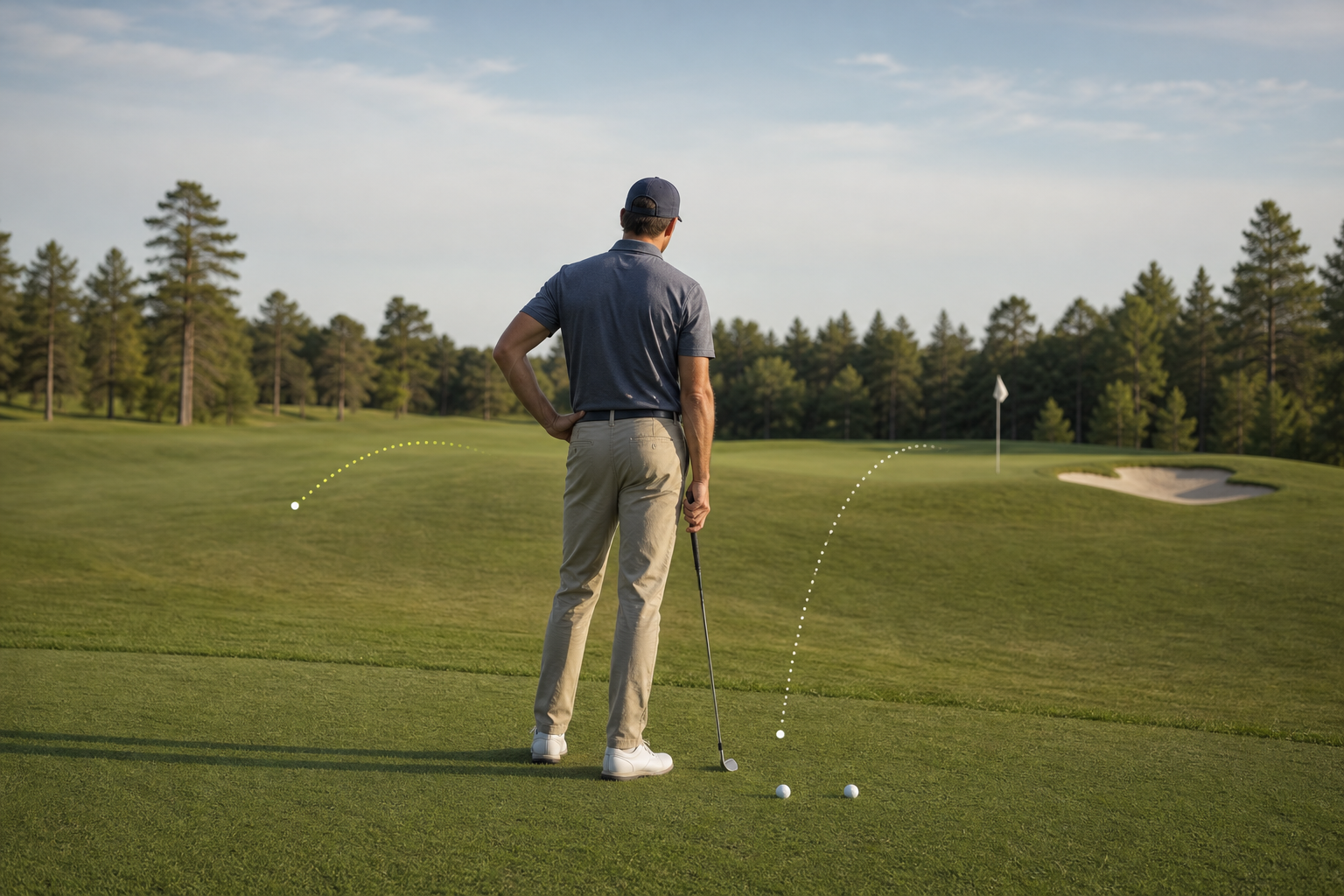
Built for: Golfers comparing golf-ball construction while balancing feel, durability, flight, and short-game control.
When one ball feels fine off the tee but leaves you uncertain on a 40-yard pitch, it is tempting to shop by layer count. Start instead with the shot that is costing you the most predictable strokes, then compare balls only on that outcome.
The quick verdict
Two-piece versus three-piece is not a verdict on performance by itself; use construction as a shortlist filter, then choose the ball that produces the more repeatable result on the specific shot you need to improve.
Best for Golfers willing to compare a small number of balls through one repeatable on-course or practice-green test rather than choosing from package language alone.
Skip it if Skip a construction-led purchase if you cannot name an observable problem, such as inconsistent carry on a stock approach, uncertain rollout on chips, or a cover that does not hold up for your normal round.
Start with the shot that creates the decision
A ball choice becomes clearer when it begins with a scene from your own round. Perhaps your drives are finding the same parts of the course, but your basic greenside chip alternates between a finish well short and a finish past the hole. Perhaps your scoring ball looks worn before you have completed the round. Or perhaps the issue is simpler: you cannot tell whether a ball change has altered anything at all.
Those are different problems, and none is answered by layer count alone. Write down one observable outcome before shopping: the number of chips that finish in a target area, the carry window of a stock approach, or the condition of the cover after a normal round. A ball that helps that outcome deserves further consideration; one that does not is only a different construction.
Guild recommendation: Choose one shot category to judge first. Do not ask a single comparison to settle feel, flight, control, and durability at once.
What two-piece and three-piece labels can—and cannot—tell you
The labels tell you how the maker describes the ball’s construction category. They do not, on their own, tell you how far you will hit it, how it will feel, how it will fly, how it will react around the green, or how long its cover will last. Those are outcomes to compare, not benefits to assign automatically from the number on the package.
This matters for the golfer who sees a three-piece ball as an automatic upgrade. If the current two-piece ball already gives dependable distances and predictable chips, a layer-count change may create no useful scoring gain. The reverse is also true: a golfer who wants a more dependable greenside result should not assume every three-piece candidate will deliver it. Compare two balls directly with one club and one task.
Guild recommendation: Treat construction as a way to organize your shortlist, not as evidence that one ball is better for your game.
Match the comparison to your priority
For a player focused on durability, begin with the ball you can inspect honestly. Play or practice with comparable shots, then look for the condition that would make you retire a ball. If one option reaches that point sooner in your routine, that is a meaningful constraint regardless of its layer count.
For a player focused on short-game control, define control before making a purchase. It might mean a chip finishing inside a three-pace circle, or it might mean seeing a repeatable amount of rollout after the same landing spot. The best candidate is the one that makes your miss easier to anticipate, not necessarily the one that produces one unusually good shot.
For a player focused on flight or approach consistency, use a familiar target and one normal club. Watch for repeated carry and a usable dispersion pattern over several shots. Avoid turning one flushed strike into a conclusion. Golfers who change balls frequently often learn less because the comparison never has enough repetitions to become useful.
Guild recommendation: Prioritize durability if replacement is your frustration, greenside predictability if chip distance is your frustration, and repeated carry pattern if approach distance is your frustration.
A simple two-ball decision rule
Keep the test fair enough that the ball is the changing variable. Use the same club, lie, target, and intended shot. Alternate balls rather than hitting a full batch with one and then the other if conditions or your rhythm may change. Record only a few items that matter: target-area finishes, typical short-or-long miss, and visible wear.
Then make a narrow decision. If Ball A wins your chip test but Ball B lasts longer, choose according to the issue that genuinely affects your round more often. A golfer losing strokes through poor distance control around the green may accept a durability tradeoff. A golfer whose balls are being removed from play early may reasonably give durability greater weight. Neither choice requires a universal claim about two-piece or three-piece construction.
Guild recommendation: Commit to the ball that wins your stated test, then use it long enough to learn its normal behavior before reopening the comparison.
Rules check for competitive play
Golf balls used under the Rules of Golf must meet the applicable equipment requirements. The USGA Conforming Golf Ball List identifies balls that have been submitted and evaluated for conformance. If your event or competition uses a conformance condition, verify the ball you plan to use against the relevant requirements and list rather than relying on a construction label.
Guild recommendation: Check conformance before a competition where it matters, especially when trying an unfamiliar model.
Try this · 25 minutes.
One-Ball, One-Target Comparison
Bring two candidate ball models, a wedge, a clear practice-green landing spot, and a target area about 8 to 12 paces beyond that spot. Use the same lie and the same ball position for every shot.
- Hit six chips with the first ball, aiming to land each shot on the same spot rather than trying to force every shot to finish at the target.
- Note how many of the six finish inside your chosen target area, and note whether the misses tend to finish short or long.
- Repeat the same six-shot set with the second ball, keeping the club, landing spot, and intended motion unchanged.
- If neither ball separates clearly, repeat the comparison on a different day before deciding. Do not change your technique during the test; the purpose is to compare the results each ball gives you.
What progress looks like: A useful winner is the ball that puts more shots in the target area, or gives you a more predictable short-or-long pattern that you can plan for on the course.
Put the guide to work
These searches are a starting point—not a substitute for the fit and comparison criteria above.
Compare construction choices after your chip test
Use this search only after you know whether your priority is a more predictable tee-to-green result, a particular short-game result, or cover durability through your normal round.
Build a short-game comparison pair
Compare package information and select two candidates for the same controlled chip-and-roll test rather than assuming every three-piece model will respond alike.
Find a durable comparison candidate
Use this search when the observable concern is replacing scuffed balls too often, then inspect the cover after playing or practicing with the same type of shot.
If you buy through these links, Guild of Golf may earn a commission at no extra cost to you.
The practical takeaway
- Begin with a specific, observable performance problem rather than the number of pieces in the ball.
- Two-piece and three-piece labels are useful shortlist categories, but they do not establish the result you will get.
- Compare candidates with the same club, target, lie, and intended shot.
- Select the ball that gives the most repeatable outcome in the part of the game that most needs attention.
- Verify applicable ball-conformance requirements for competitions governed by those conditions.
Frequently asked questions
Is a three-piece ball automatically better than a two-piece ball?
No. Construction count alone does not establish a better result for your game. Compare the balls on one measurable priority, such as chip rollout, approach carry pattern, or visible wear after normal use.
Should I choose a ball for feel or for durability?
Choose the constraint that changes your round more often. If you are retiring balls because of their condition, evaluate durability first. If your problem is judging greenside distance, use a repeatable chip test and favor the ball with the more predictable result.
How many shots should I use to compare golf balls?
Use enough shots to see a pattern rather than a single exceptional strike. A six-shot set per ball is a practical starting point for a chip comparison, and repeating the test on another day adds confidence.
Do I need to use a conforming golf ball?
Golf balls used under the Rules of Golf must meet applicable equipment requirements. For a competition with a conformance condition, consult the relevant rules and the USGA Conforming Golf Ball List before play.
Sources used for this draft
- USGA Equipment Rules — The requirement that golf balls used under the Rules of Golf meet applicable equipment requirements.
- USGA Conforming Ball List — The description of the list as identifying balls submitted and evaluated for conformance.
Guild of Golf may earn a commission from qualifying purchases made through shopping links, at no additional cost to you.