
comparison
Putting Mirror vs. Mat: Choose for the Putt You Can Measure
A purposeful guide to choosing a putting mirror or putting mat by starting with an observable miss, then using one tool to make home practice more specific.
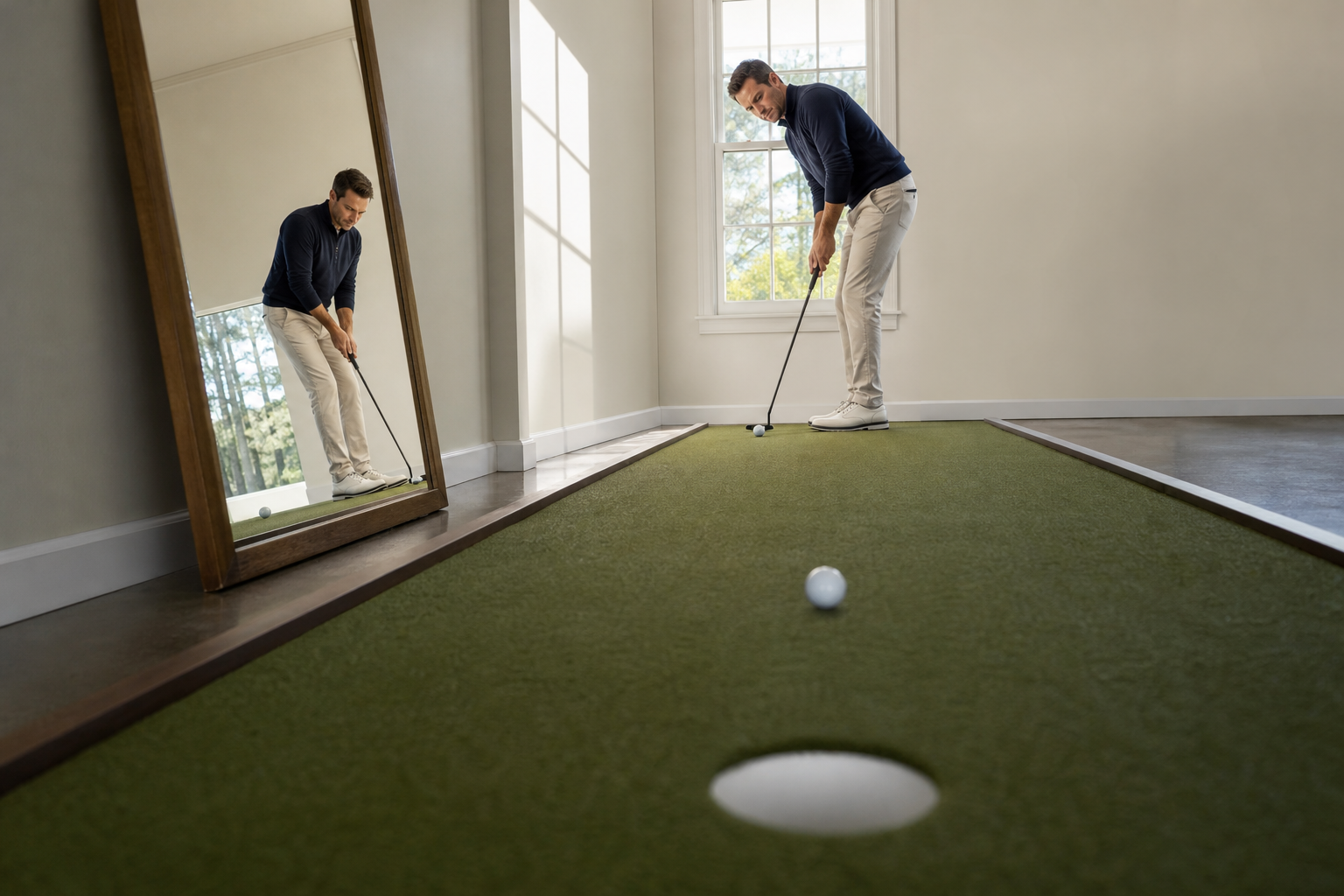
Built for: Golfers choosing one practice aid and deciding whether they need setup feedback or ball-roll feedback.
When a short putt misses, the temptation is to buy a complete practice station. Start smaller. Identify whether your repeatable problem appears before the stroke or after the ball leaves the face, then choose the aid that gives you a visible answer.
The quick verdict
Choose a putting mirror when your main question is whether you are repeatedly arriving at the ball in the setup you intended; choose a putting mat when you need a repeatable place to judge where putts start and how they travel toward a target.
Best for A mirror suits golfers who can point to a recurring address or alignment concern, while a mat suits golfers who will regularly hit putts and record a simple ball-roll result.
Skip it if Skip both as a first purchase if you cannot name an observable putting problem or cannot commit to a short, repeatable practice routine.
Start with the evidence from your last three-putt hole
A mirror and a mat can both make practice feel productive, but they do not answer the same question. Think about the miss you can describe without guessing. Perhaps you stand over a three-footer and repeatedly feel unsure whether you aimed as intended. That is a pre-stroke problem you can observe at address. Or perhaps your setup feels settled, yet putts begin inconsistently or arrive short of a defined target. That is an outcome problem: the ball either starts through your chosen window and reaches the target area, or it does not. Practice is more useful when it has a defined purpose and structure, so the first job is to name one result you will track rather than collect several drills.
Guild recommendation: Write down one observable pattern before shopping, such as “I do not know whether my address is repeatable” or “fewer than half of my short putts start through my gate.”
Choose a putting mirror for a question at address
A putting mirror is the narrower choice. Its value is not that it guarantees a better stroke; it gives you a way to inspect the position you bring to the ball before the stroke begins. Choose it when your home session is likely to begin with a consistent visual check: where you stand, how the putter is presented, and whether your intended alignment picture is repeatable. This is especially sensible for the golfer who keeps changing setup from putt to putt because the address never looks or feels settled. A mirror is less satisfying for someone who wants every session to include repeated rolls to a distant target, because reflection is its central feedback rather than the travel of the ball.
Guild recommendation: Buy a mirror if you will use it to repeat one defined address checkpoint before rolling a small number of putts to a target.
Choose a putting mat for a question after impact
A putting mat gives you a dedicated lane for repetitions. Its useful feedback is simpler and more practical: did the ball begin through your chosen start window, and did it finish at the target with the result you intended? That makes it the better first choice for a golfer with limited practice time who will benefit from a stable distance and a clear target. Picture the player who loses confidence on four-footers because every home session is on a different patch of carpet. A mat can make the task consistent enough to record ten attempts instead of relying on memory. It cannot, by itself, tell you why a ball missed, so avoid turning one missed putt into a verdict about your mechanics.
Guild recommendation: Buy a mat if you will roll enough putts to keep a basic count of starts through a gate and finishes at a target.
Do not confuse a tidy setup with a scored result
The sensible order is problem, feedback, then repetition. A golfer who sees a repeatable address concern may begin with a mirror, use one visual checkpoint, then roll a few putts to verify that the session has a target. A golfer whose immediate need is reliable ball-roll practice may begin with a mat and use a gate to make the result more precise. There is no requirement to own both. The second aid becomes useful only when the first one leaves a question unanswered. This keeps your home station focused and gives each practice session one job.
Guild recommendation: Add the other tool only after you can state what your current aid cannot show you during a normal session.
What to compare after you know which feedback you need
For a mirror, compare whether the reflective area allows a comfortable view at your normal address, whether it lies securely where you practice, and whether any visual guides help rather than distract from your single checkpoint. For a mat, compare whether the length fits the putts you will realistically practice, whether the target is easy to define, and whether it can remain flat in the room where you will use it. A compact aid that is easy to set out can be more useful than a larger option that stays stored away. Rules governing putting greens provide context for putting and lines of play, but an indoor aid is still a practice environment rather than a substitute for reading and responding to a course green.
Guild recommendation: Prioritize a tool that fits your available floor space and supports one recorded outcome over one with features you cannot explain how you will use.
Try this · 10 minutes.
The 12-Putt Evidence Check
Create a straight, short putting lane on a level indoor surface or practice mat. Place a target about four feet away and make a start gate just wider than the ball with two small household objects set safely outside the ball’s path. If using a mirror, place it as directed by its maker so you can view your normal address before each putt.
- Hit six putts using your ordinary routine. Before each stroke, note one setup detail you can see with the mirror, if you have one, or simply settle into your intended address. Record whether each ball passes through the start gate and reaches the target area.
- For the next six putts, keep the same distance and target. Change only one intentional setup choice that you can describe in plain language, such as where you place the ball relative to your stance, and continue to record start-gate results.
- Review the two groups. Do not search for a swing diagnosis; look only for whether one clearly defined setup produces a more repeatable start result under the same conditions.
What progress looks like: You have a useful practice direction when one clearly described setup produces more start-gate passes across six putts, or when your record shows that setup is not the observable issue you need to work on next.
Put the guide to work
These searches are a starting point—not a substitute for the fit and comparison criteria above.
Compare putting mirrors
Compare the reflection area, whether the layout fits your usual address, and whether the mirror can sit securely on the surface where you will actually practice.
Compare putting mats
Compare the available straight-putt length, the clarity of the target, and whether the mat can stay flat and usable in your intended practice space.
If you buy through these links, Guild of Golf may earn a commission at no extra cost to you.
The practical takeaway
- Pick the aid from an observable problem, not from the desire for a more elaborate practice setup.
- A putting mirror is for checking a repeatable address picture before the stroke.
- A putting mat is for repeating a ball-roll task toward a defined target.
- Use a simple record of starts and finishes so practice has a purpose instead of becoming random repetition.
- One aid used consistently is a better starting point than two aids used without a clear question.
Frequently asked questions
Should I buy a putting mirror or mat first?
Buy the mirror first if your clearest concern is what you see at address. Buy the mat first if your clearest concern is producing repeatable starts and finishes toward a target.
Can a putting mirror replace a putting mat?
It can support a focused setup check and can be used before rolling putts on an appropriate surface, but it does not create the same dedicated, repeatable ball-roll lane as a mat.
Can a putting mat show me why I miss?
A mat can help you record a visible result, such as whether the ball passes through a start gate and reaches a target. It does not establish the cause of a miss, so keep conclusions modest and test one intentional change at a time.
What makes home putting practice purposeful?
Give the session one defined target, keep the conditions consistent, record a small number of attempts, and decide what you will repeat or change from the evidence you collected.
Sources used for this draft
- PGA of America: Practice With Purpose — The value of defined purpose and structure in practice.
- USGA Rule 13: Putting Greens — The rules context for putting greens and lines of play.
Guild of Golf may earn a commission from qualifying purchases made through Amazon links, at no additional cost to the buyer.