
comparison
Putting Mirror or Mat? Match the Aid to the Putt You Can Measure
Choose a putting mirror or putting mat by starting with an observable miss, then buying only the feedback that helps you work on it at home.
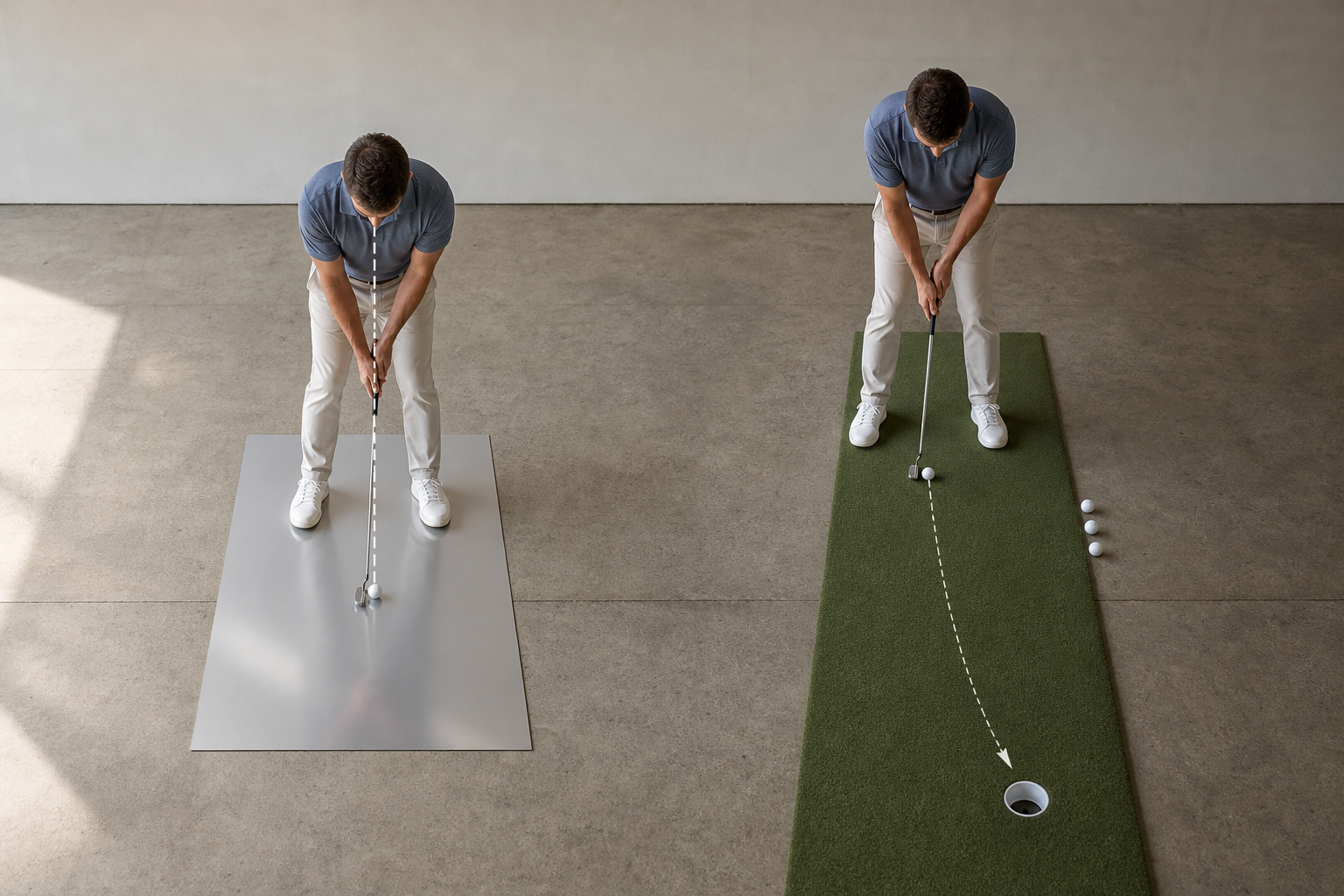
Built for: Golfers choosing one practice aid and deciding whether they need setup feedback or ball-roll feedback.
A mirror helps when the uncertainty is what you look like at address; a mat helps when the uncertainty is whether a repeated stroke starts the ball on the intended line.
The quick verdict
Buy a putting mirror when your recurring problem is an uncertain or inconsistent setup, and buy a putting mat when you need a repeatable home target for observing starts, pace, and completion of short putts.
Best for The mirror is best for golfers who can name a setup question before each putt, while the mat is best for golfers who will regularly putt to a defined target in limited space.
Skip it if Skip both for now if you cannot state one observable putting task you will repeat, because an unfocused routine turns either aid into floor clutter.
Start with the putt that gives you evidence
The familiar home-practice trap is buying the tool that looks most complete, then rolling a few casual balls until the session feels busy. Instead, begin with a moment from the course you can describe without interpreting it. Perhaps short putts make you feel cramped over the ball, and you keep resetting your feet. Perhaps your address feels settled, yet three five-footers start left, center, and right of the intended line. Those are different performance problems, so they deserve different feedback. Purposeful practice has a defined purpose and structure, an approach emphasized by the PGA of America.
Guild recommendation: Choose the aid only after you can complete this sentence: “On a short putt, I want to observe whether my setup repeats” or “I want to observe whether the ball repeatedly starts toward my target.”
Choose a mirror for an address question
A putting mirror earns its place when you need a consistent visual reference before the stroke. It suits the player who looks down and cannot tell whether ball position, eye position, putter-face presentation, or stance picture has changed from one attempt to the next. The useful outcome is not a supposedly perfect pose. It is the ability to recreate one chosen, comfortable setup and then see whether that repeatability carries into a short-putt task. A mirror is compact and direct, but it does not by itself provide a destination or require you to observe the eventual roll closely.
Guild recommendation: Prioritize a mirror that stays put on your usual surface and gives you enough uncluttered reflective area to see your normal address position. Skip extra markings that do not answer your specific setup question.
Choose a mat for a ball-roll question
A putting mat is the better first purchase when the missing ingredient is a defined start point and target. It gives you a repeatable lane for a simple question: did this ball begin toward the intended target, and did it reach the finish with the intended pace? That constraint matters for the player whose practice otherwise consists of tapping balls across carpet with no consistent distance or endpoint. The tradeoff is that a mat can make practice convenient without revealing much about the visual details of your address, especially if you never pause to check them.
Guild recommendation: Prioritize a mat that fits flat in the space you will genuinely use and has a clear target you can reach with a short, repeatable putt. Skip oversized options if they will spend more time stored than on the floor.
Do not ask one aid to solve both jobs
A mirror and a mat can complement each other, but buying both immediately can blur the session. Consider two golfers preparing for a round. One has begun to hesitate because the ball appears in a different place under their eyes each time; the mirror keeps the practice question narrow. The other is comfortable standing over the ball but rarely practices toward a consistent start point and finish; the mat creates a measurable task. Neither tool changes the rules context of play on the putting green, which is addressed in Rule 13. They are simply home-practice tools for creating more deliberate repetitions.
Guild recommendation: If you eventually add the second aid, keep the roles separate: use the mirror for a brief setup check, then put it aside and use the mat to complete a defined rolling task.
Compare features only after the job is clear
Once you know the feedback you need, comparison becomes simpler. For a mirror, ask whether it is stable, visible from your normal address, and portable enough that you will use it. For a mat, ask whether it fits your floor, provides a repeatable start and target, and can be put away without turning practice into a setup project. Resist shopping by the longest feature list. A feature is worthwhile only when it makes the next repetition easier to observe or repeat.
Guild recommendation: Use the focused searches below to compare the few features tied to your chosen job, rather than treating either category as a cure for every putting miss.
Try this · 15 minutes.
The One-Question Putting Session
Choose a flat, clear indoor area, a putter, three balls, and either your mirror or mat. If using a mirror, place a small target such as an overturned cup or tape mark about three to five feet away; if using a mat, use its hole or end target. Keep the same start point for every putt.
- Write one observable question before starting: either “Can I return to the same address picture?” for a mirror or “Can I start five balls toward the same target?” for a mat.
- For five rehearsals with a mirror, take your normal address, look at the setup picture, step away, and rebuild it without changing your putter. Then roll one ball to the target.
- For five balls on a mat, use the same start point and make one stroke to the target each time. Watch whether each ball begins on the intended route and whether it finishes at or through the target.
- Repeat one more set of five, changing nothing except your attention to the chosen question. Do not add a second drill during the session.
- Record only the number of repetitions that met your stated task, then stop.
What progress looks like: Your useful signal is a higher count of repeatable setups or intended starts in the second set, not a claim that the aid has diagnosed the cause of a miss.
Put the guide to work
These searches are a starting point—not a substitute for the fit and comparison criteria above.
Compare simple putting mirrors
Compare the usable reflective area, whether it lies securely on your practice surface, and whether its markings help you answer one specific setup question without crowding your address.
Compare compact putting mats
Compare the mat length against your available floor space, the clarity of the target, and how easily you can recreate the same starting spot for repeated ball-roll practice.
If you buy through these links, Guild of Golf may earn a commission at no extra cost to you.
The practical takeaway
- Begin with an observable short-putt problem rather than with a product category.
- A mirror is for repeating and checking a chosen address picture.
- A mat is for repeating a start point, target, and short ball-roll task.
- A 15-minute session with one question produces more useful feedback than a long session with several competing drills.
- Buy the aid that fits both the feedback you need and the floor space you will actually use.
Frequently asked questions
Should a beginner buy a putting mirror or a putting mat first?
A beginner should choose the one that makes practice easiest to define. Pick a mat if a clear target and repeated short putts are missing; pick a mirror if rebuilding a consistent address picture is the immediate uncertainty.
Can I practice with a putting mirror without a mat?
Yes. Set a small target on a flat, clear surface and use the mirror to repeat a chosen setup before rolling short putts toward that target.
Can a putting mat tell me why I miss putts?
No. A mat can help you observe repeated starts and finishes in a controlled home task, but it does not establish the cause of a miss.
How often should I use a home putting aid?
Use a home putting aid when you can state one task, repeat it from the same start point, and record a simple result. Short, structured sessions align with the purposeful-practice approach described by the PGA of America.
Sources used for this draft
- PGA of America: Practice With Purpose — The value of giving practice a defined purpose and structure.
- USGA Rule 13: Putting Greens — The rules context for putting greens and lines of play.
Guild of Golf may earn a commission from qualifying purchases made through eligible shopping links, at no extra cost to you.