
comparison
Putting Mirror vs. Mat: Choose the Feature for the Putt You Can Measure
A purposeful way to choose a putting mirror or putting mat by starting with the on-course result you can observe, then buying only the feedback that addresses it.
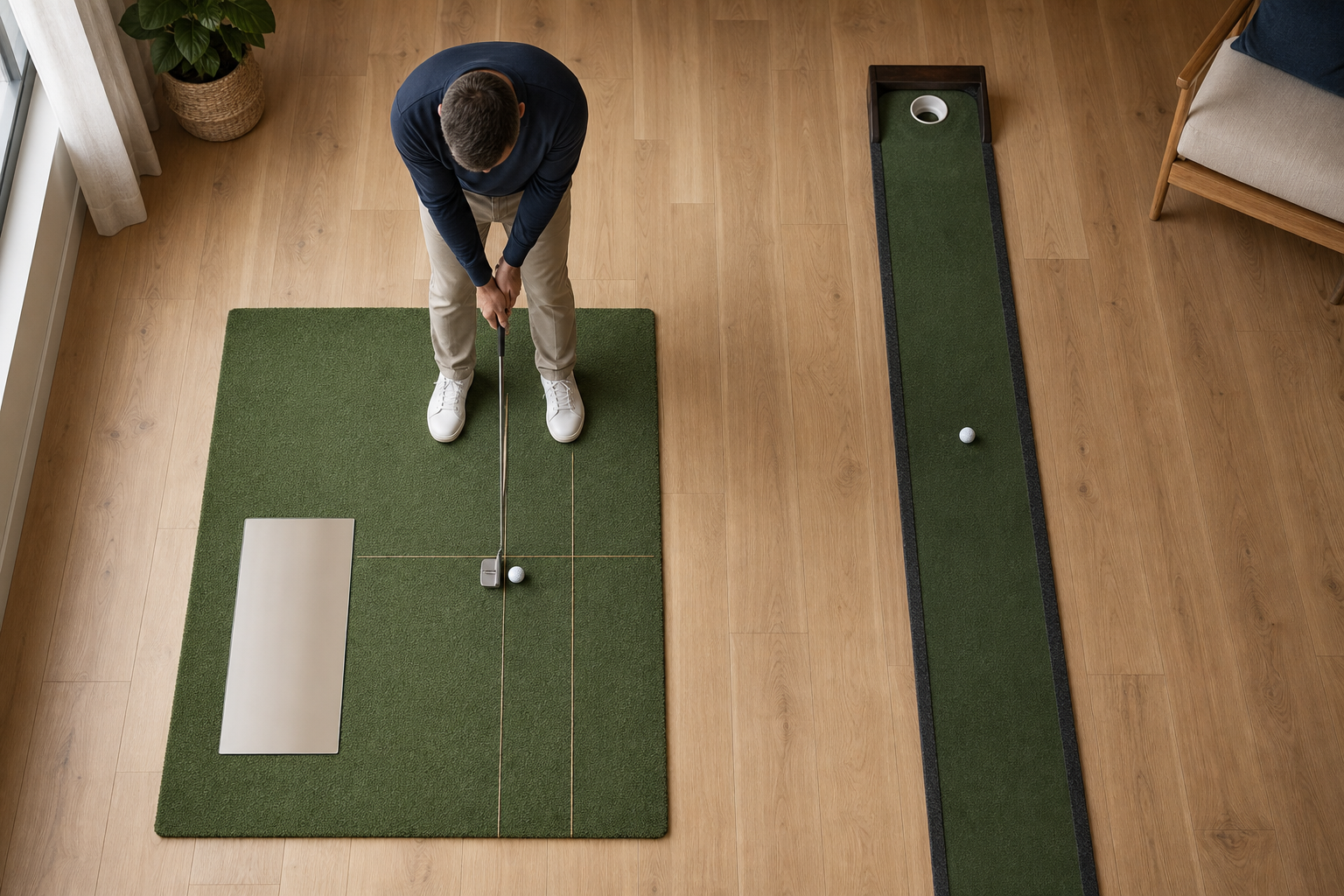
Built for: Golfers choosing one home-practice aid and deciding whether they need setup feedback or ball-roll feedback.
When four-footers keep starting somewhere other than intended, a mirror and a mat can look like interchangeable answers. They are not. A mirror makes your address position observable; a mat creates repeatable putts toward a target. Choose the tool that lets you measure the specific part of the putt you are currently missing.
The quick verdict
Buy a putting mirror when your observable problem is an inconsistent or uncertain address picture, such as repeatedly feeling unsure where your eyes, putter face, or ball sit at setup. Buy a putting mat when you need a dependable home lane for repeating a start line and judging whether the ball reaches a chosen target. If you can purchase only one, select the aid that turns your most common, visible miss into a simple repeatable check.
Best for A mirror is best for golfers who want to rehearse one consistent pre-putt picture. A mat is best for golfers who have limited access to a smooth indoor putting surface and will practice toward a target several times each week.
Skip it if Skip a mirror if looking at setup will make you chase several positions at once instead of committing to one simple checkpoint. Skip a mat if it will become a rolled-up accessory rather than a defined practice station with enough clear floor space to use it.
Start with the putt that bothers you on the course
Picture the familiar late-round putt: four feet, a simple read, and a strike that never seems to begin on the line you selected. Before buying an aid, describe the problem without guessing at its cause. “I cannot settle into the same address picture” is a setup-observation problem. “I do not have a reliable place at home to roll putts at a target” is a ball-roll practice problem. Those statements point to different tools and keep a practice purchase from becoming another vague attempt to fix putting.
Guild recommendation: Write down one observable problem from your last round or practice session, then buy only the aid whose feedback answers that problem.
A mirror is for making the address picture visible
A putting mirror belongs in a practice plan when uncertainty begins before the stroke. It provides immediate visual reference at address, allowing a golfer to check one selected relationship rather than relying entirely on feel. That can suit the player who stands over a short putt and repeatedly rebuilds the setup, or the golfer whose ball position seems to wander from session to session. The tradeoff is that a mirror is not a destination by itself: once the ball is moving, it does not give a target lane or a meaningful result to judge. Its value depends on choosing one reference, checking it briefly, and then rolling the putt.
Guild recommendation: Choose a mirror with enough usable reflective area to see your intended address checkpoint in your actual practice space, and avoid treating it as a reason to inspect every part of your posture.
A mat is for repeating a target-and-roll task
A putting mat is the better first purchase when the obstacle is practical: no consistent indoor surface, no clear target, and therefore no routine for rolling putts. A defined lane lets you use the same start point and target across sessions. That makes a simple outcome observable: did the ball begin near the intended line, and did it finish near the target? A mat cannot tell you why a ball missed, and it should not be used to assume that indoor performance will duplicate every outdoor green. Its advantage is repeatability, which gives purposeful practice a structure instead of turning each session into random strokes.
Guild recommendation: Choose a mat that fits the uninterrupted space you can genuinely leave available, with a target you can see clearly from address and enough length for the putts you plan to rehearse.
Choose the feature, not the category
The most useful shopping comparison is not mirror versus mat in the abstract. Compare the feature that solves the constraint in front of you. In a narrow apartment hallway, storage and usable length may decide whether a mat sees regular use. In a room where a mat is already available, a compact mirror may add the missing setup reference. A golfer who can roll plenty of putts but cannot tell whether the ball position is consistent has little need for a larger target system. Conversely, a player with a consistent setup routine but no repeatable indoor target gains more from a mat than from extra visual references.
Guild recommendation: Before searching, state the feature requirement in one sentence, such as “I need one visible ball-position reference” or “I need a six-foot lane I can set up quickly.”
Keep home practice connected to the game
Purposeful practice works best when it has a defined purpose and structure, rather than a pile of repetitions. Use the aid to rehearse one controllable task, then judge the ball against a target. On the course, putting takes place under the rules context of the putting green and the line of play, but home practice need not imitate every playing condition to be useful. The practical goal is narrower: arrive at the course with a familiar setup routine or a more dependable habit of rolling the ball toward a chosen target.
Guild recommendation: End each home session by rolling several putts with your normal routine and no additional adjustment, so the aid supports the routine instead of replacing it.
Try this · 12 minutes.
The One-Variable Home Putting Check
Create a straight, clear indoor putting lane with a ball, putter, and a small target such as a cup or coin. If using a mat, use its target; if using a mirror, place it so it can show your address position without obstructing the ball. Choose one starting distance that allows you to roll the ball to the target under control.
- Roll five putts toward the target without changing your normal routine, and note only the observable result: whether each ball starts near the intended line and finishes near the target.
- For the next five putts, use a mirror only to confirm one chosen setup checkpoint before you stroke the putt, such as the ball’s position relative to the putter face. Do not add a second checkpoint.
- For the final five putts, use the same target and routine, then compare the first and final groups by counting how many balls started close to the intended line and finished near the target.
- Repeat the session on another day with the same distance before changing the target, surface, or checkpoint.
What progress looks like: The useful signal is a repeatable improvement in the number of putts that begin near the intended line and finish near the target, not a perfect-looking address position.
Put the guide to work
These searches are a starting point—not a substitute for the fit and comparison criteria above.
Compare mirror size and reference features
Compare whether the reflective area gives you a clear view of the single setup checkpoint you intend to use, plus whether it fits the floor space where you will practice.
Compare mat length and target design
Compare the usable putting length, the clarity of the target, and whether the mat can remain accessible enough for regular sessions.
If you buy through these links, Guild of Golf may earn a commission at no extra cost to you.
The practical takeaway
- Choose from an observable performance problem, not from the appeal of a more elaborate practice setup.
- A putting mirror is most useful when you need one clear, repeatable setup reference.
- A putting mat is most useful when you need a stable home lane and target for repeated ball-roll practice.
- One checkpoint and one target produce more useful feedback than changing several variables during the same session.
- Compare practical fit first: reflective viewing area for a mirror, and usable length, target clarity, and storage for a mat.
Frequently asked questions
Should a beginner buy a putting mirror or a putting mat first?
Start with the aid that removes the bigger practical obstacle. Choose a mat if the beginner lacks a reliable place to roll putts toward a target, and choose a mirror if the main difficulty is establishing the same simple address picture before each putt.
Can a putting mirror replace a putting mat?
No. A mirror can provide setup feedback, while a mat provides a repeatable surface and target task. Either can be valuable alone when it addresses the golfer’s stated problem.
What should I compare before buying a putting mirror?
Compare the usable reflective area, whether it lets you view the one checkpoint you plan to use, and whether it fits safely in the practice space you have.
What should I compare before buying a putting mat?
Compare usable length, target visibility, the amount of unobstructed floor space required, and whether the mat can be stored or left accessible for frequent practice.
Sources used for this draft
- PGA of America: Practice With Purpose — The recommendation to give practice a defined purpose and structure.
- USGA Rule 13: Putting Greens — The rules context for putting greens and lines of play.
Guild of Golf may earn a commission from qualifying purchases made through affiliated shopping links, at no added cost to the buyer.