
comparison
Forged vs. Hollow-Body Irons: Choose From Your Miss, Not the Label
Forged and hollow-body labels can describe different iron constructions, but the useful choice starts with the shot pattern a golfer can actually observe and measure.
Built for: Golfers comparing iron constructions who want to separate manufacturing terms from on-course fit and performance.
Before treating feel or construction as a promise, identify the iron shot that is costing you strokes, then compare candidates with the same shaft, loft context, and measured results.
The quick verdict
Forged and hollow-body are not automatic answers to a thin strike, an unpredictable carry number, or an uncomfortable look at address; use either category only when a fitting comparison shows it improves the result you are trying to change.
Best for Golfers who can name an observable priority, such as a tighter landing pattern with a mid-iron, a more reliable carry gap, or a look and feel that helps them make a committed swing.
Skip it if Skip a construction-led purchase if you are hoping a label alone will fix a broad contact or directional pattern, or if you cannot compare clubs with measured results.
The 7-iron that looks good in the shop but misses the green.
A common iron decision starts after a frustrating approach: one 7-iron comes off the face with a sensation you enjoy, while another sends a few shots nearer the target. It is tempting to turn that moment into a simple rule—forged for feel, hollow-body for help—but that rule does not identify your actual problem. Was the costly miss short of the front edge, far right of the green, or simply a strike that felt unfamiliar? Those are different observations, and a construction label is not a diagnosis.
Guild recommendation: Write down one on-course problem in observable terms before comparing irons. “My 7-iron often finishes short of the front bunker” is actionable; “I need better irons” is not.
Treat construction as a description, not a performance guarantee.
Forged and hollow-body are useful words for sorting iron options, but they do not replace a measured comparison. The USGA’s equipment rules apply to conforming clubs regardless of marketing category or construction method, which is a useful reminder that construction labels do not sit outside the same equipment framework. More importantly for a buyer, neither label tells you by itself whether a particular head, shaft, length, lie, loft progression, and your delivery will produce the most useful result.
Guild recommendation: Do not purchase from the category name alone. Compare the whole club specification and keep the club number, target, ball type, and testing conditions as consistent as possible.
Let the miss choose the question.
If your issue is a troublesome distance gap, the question is whether a candidate produces a dependable carry pattern at the lofts in the set, not whether it belongs to the forged or hollow-body shelf. If your issue is directional uncertainty, watch the start and finish pattern around a target rather than chasing one memorable ball. If you hesitate over an iron because the shape, sound, or impact sensation makes you guide the swing, that response matters too—but it should be weighed beside the ball result. Feel is valuable when it helps you make a normal, committed motion; it is not proof that the club will deliver a better on-course pattern.
Guild recommendation: Match one comparison measure to one problem: carry pattern for gapping, finish area for target control, and address comfort for confidence. Avoid changing all three priorities at once.
What a fitting can settle that labels cannot.
A fitter can help turn impressions into a decision by comparing club options with measured results. The PGA of America advises that fit and measured results matter when comparing clubs. Bring a clear priority and tell the fitter what you see on the course: a recurring short-side miss, a carry gap, a preferred flight window, or a club that you avoid on a long approach. Then ask to compare options without assuming which construction should win.
Guild recommendation: Ask for a side-by-side comparison that records carry, dispersion, and the setup details used for each candidate. A good outcome is a club choice tied to your stated need, not a verdict on which construction is universally superior.
Where each choice can make sense.
A forged iron can be a sensible candidate for the golfer who values its particular shape, impact response, and the confidence those traits create, provided the measured pattern supports the choice. A hollow-body iron can be a sensible candidate when a model produces the carry and dispersion pattern a golfer needs, again confirmed in comparison. Either can be the wrong fit when the desired result is assumed from the label instead of demonstrated. This is especially important for the golfer who hits a few excellent range shots with a new iron, then discovers that the set does not create useful gaps or predictable approach distances on the course.
Guild recommendation: Choose the individual model that addresses your recorded problem. Skip any option that only wins on a showroom impression but does not hold up in a controlled comparison.
Try this · 25 minutes.
Alternate-Iron Target Pattern Check
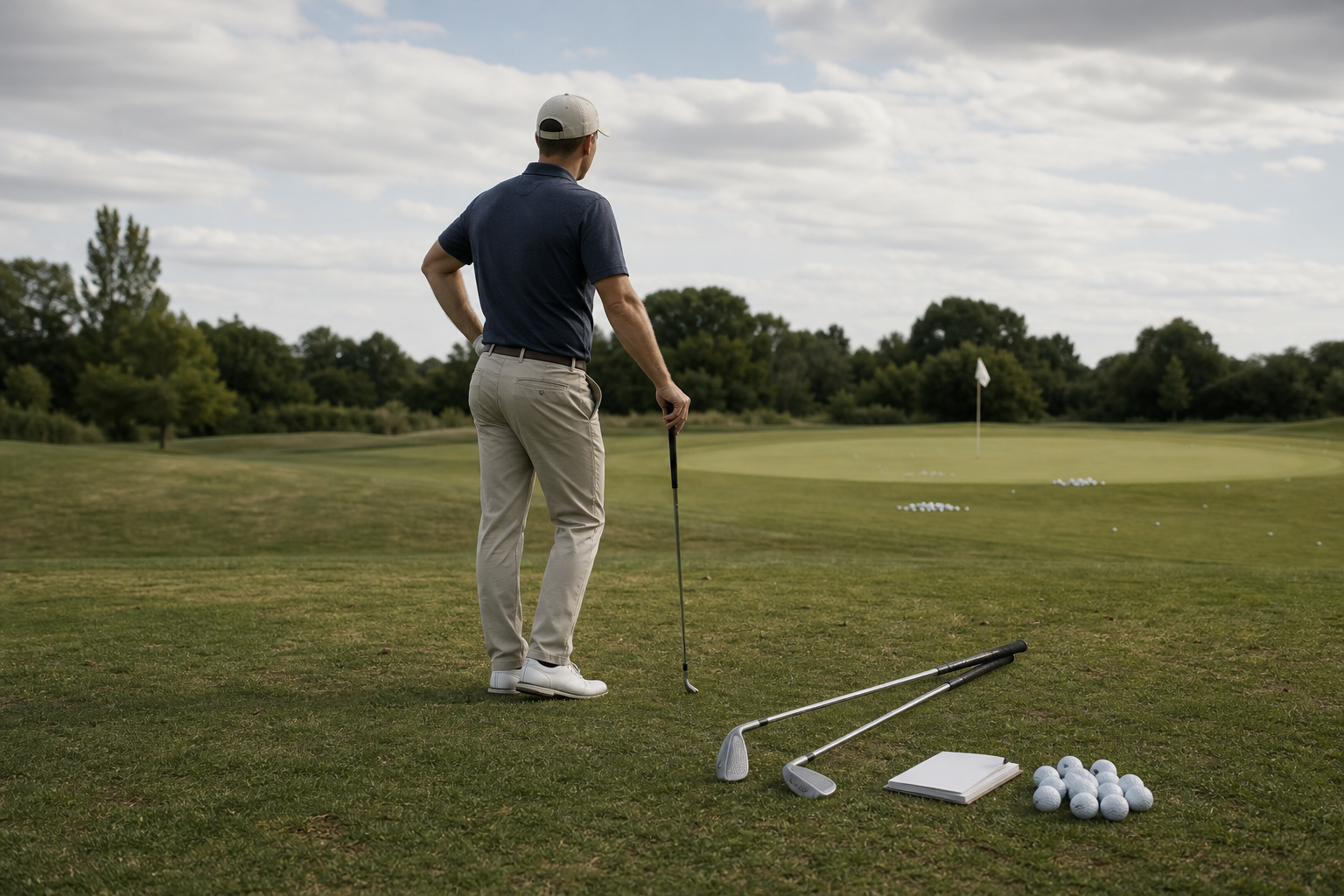
Use a practice range with a clearly visible target and safe hitting space. Select two demo irons of the same stated club number if possible, use the same ball type, and choose a target that is comfortably within normal range distance. Place an alignment stick or club on the ground to define the intended start line, then make a simple note sheet with columns for club, start direction, finish area, contact impression, and carry result if a reliable distance reference is available.
- Hit three warm-up balls with any familiar club, without recording them.
- Hit six balls with the first iron and six with the second, alternating one ball at a time so fatigue and rhythm do not favor one option.
- For every shot, record only what you can observe: whether it began near the target line, its general finishing area, and whether contact felt centered, low, high, heel-side, or toe-side to you.
- If the range has reliable distance markers or a fitting monitor is available, record the displayed or observed carry result for each shot. Do not estimate carry from a single unusually strong shot.
- Review the two groups. Look for the option that produces the more usable cluster for your intended target while still giving you a look and feel that lets you swing without steering the club.
What progress looks like: A useful result is not a perfect group of shots; it is a repeatable difference in the landing pattern, carry pattern, or your ability to aim and swing freely that can be checked again in a proper fitting.
Put the guide to work
These searches are a starting point—not a substitute for the fit and comparison criteria above.
Compare forged iron sets.
After identifying the shot pattern you want to improve, compare stated lofts, available shaft choices, set composition, and whether a fitting can verify the result.
Compare hollow body iron sets.
Use this search to find candidates for the same measured comparison, not as a shortcut to a promised flight, distance, or forgiveness outcome.
Compare iron fitting accessories.
If working with a qualified fitter, tools that help document setup and impact context can support a more disciplined comparison.
If you buy through these links, Guild of Golf may earn a commission at no extra cost to you.
The practical takeaway
- Begin with the costly shot pattern you can observe on the course, not with a construction preference.
- Forged and hollow-body labels do not guarantee a particular result for every golfer.
- Keep comparison conditions consistent and judge candidates by a useful pattern, not one exceptional shot.
- Measured fitting results should guide the final choice of head, shaft, and set configuration.
- Feel belongs in the decision when it helps you make a committed swing and the ball result supports it.
Frequently asked questions
Are forged irons automatically better for feel?
A golfer may prefer the feel of a particular forged model, but the label alone cannot establish what you will feel or how the club will perform. Compare your own impact response alongside a consistent target and carry pattern.
Will hollow-body irons automatically solve short iron shots?
No construction label automatically solves a short approach pattern. First determine whether the shots are short because of contact, carry gapping, target selection, or another factor, then use measured comparison to see whether a candidate helps.
What should I bring to an iron fitting?
Bring your current iron set, an example of the on-course shot you want to improve, and a clear priority such as dependable carry spacing or a tighter finishing pattern. Ask for measured side-by-side results rather than a category-based recommendation.
Can both constructions be conforming?
Conforming club requirements apply regardless of marketing category or construction method, according to the USGA Equipment Rules. Confirm the status of any specific club through the appropriate equipment-conformance resources when needed.
Sources used for this draft
- USGA Equipment Rules — Conforming club requirements apply regardless of marketing category or construction method.
- PGA of America: Club Fitting — Fit and measured results matter when comparing club options.
Guild of Golf may earn a commission from qualifying purchases made through shopping links, at no additional cost to the reader.