
comparison
Putting Mirror or Mat? Choose by the Putt You Can Observe.
A practical choice between a putting mirror and putting mat, based on the visible problem you want home practice to address.
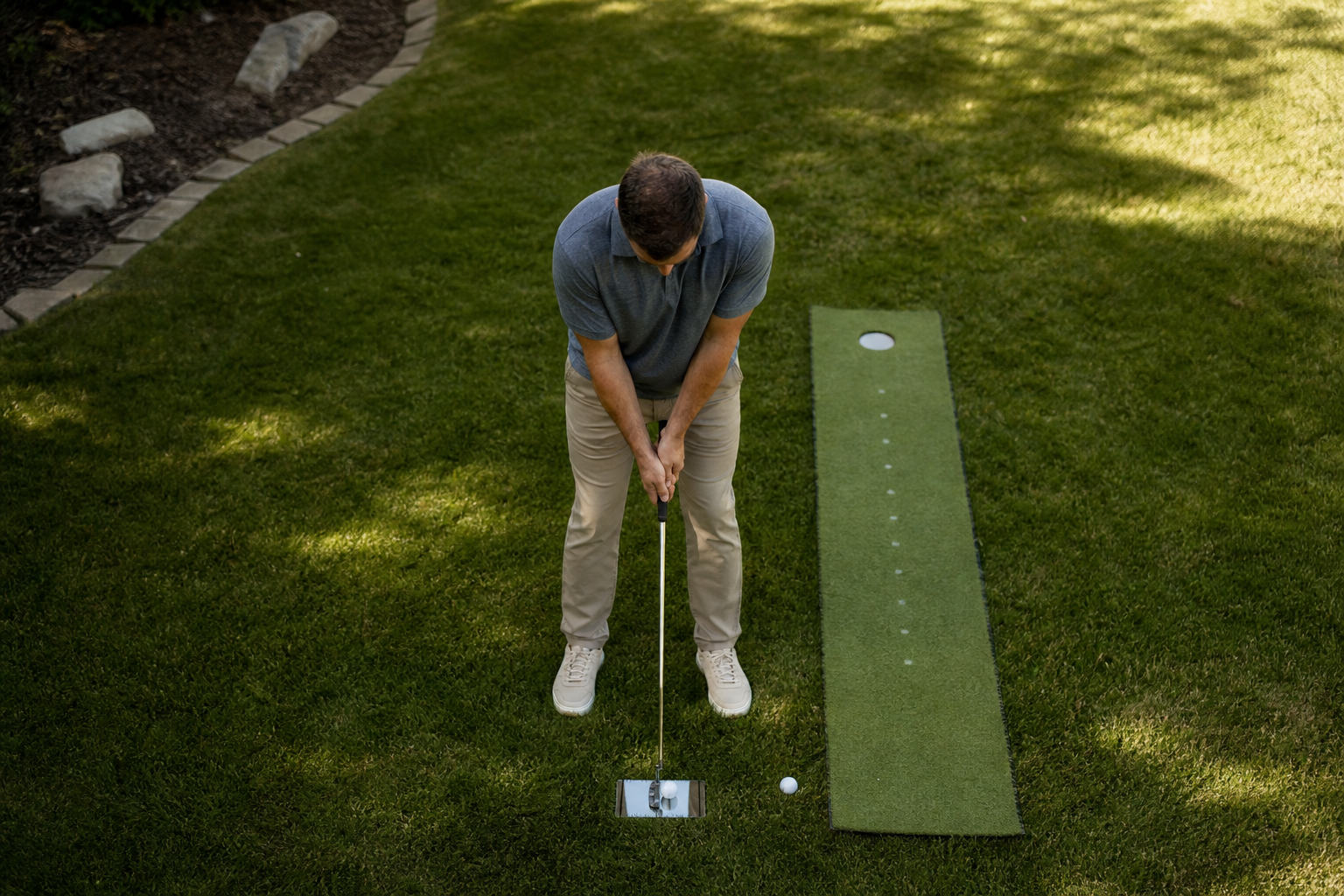
Built for: Golfers choosing one practice aid and deciding whether they need setup feedback or ball-roll feedback.
If a short putt starts left, dies at the hole, or feels different every time, do not buy both aids by default. Choose the tool that makes your specific, observable problem easier to see and repeat.
The quick verdict
Choose a putting mirror when you cannot reliably tell whether your address position and intended start line match. Choose a putting mat when your setup feels settled but you need a repeatable target and a clear result from the ball’s roll. One useful feedback loop is better than two unused practice aids.
Best for A mirror is best for golfers who notice uncertain aim, inconsistent ball position, or a different-looking setup from one putt to the next. A mat is best for golfers who want a defined indoor putting lane, a target, and repeated evidence of whether the ball reaches the intended finish.
Skip it if Skip a mirror if reflecting on setup makes you fidget without changing an observable issue. Skip a mat if there is no practical floor space to leave it down or roll it out regularly. Neither tool can recreate the changing surfaces and lines encountered on a putting green.
Start with the evidence your miss gives you.
A golfer who stands over a four-footer and repeatedly wonders, “Am I aimed where I think I am?” has a setup-feedback problem. A golfer who likes the look of the address but sees putts arrive short, run past, or finish inconsistently has a ball-roll-result problem. Those are different questions, so they deserve different tools. Purposeful practice begins by defining the question before collecting equipment.
Guild recommendation: Watch six short putts to one target before buying. If you can name an inconsistent feature of your address, lean mirror. If the address seems stable but the finish varies, lean mat.
A mirror is for making the address picture visible.
A putting mirror keeps attention close to the ball: where your eyes appear, where the ball sits, and whether the putter is presented in the same visual relationship each time. That is useful for the golfer whose pre-putt routine produces a different picture from rep to rep. For example, if one attempt feels comfortable and the next feels crowded, a mirror gives you a stable reference before the ball moves. Its limitation is equally important: once the putt is struck, the mirror does not give a long, repeatable lane in which to judge the result.
Guild recommendation: Buy a mirror first when your useful practice cue is an address check, not a scorecard-like make or miss count.
A mat is for giving the roll a repeatable destination.
A putting mat turns a patch of home floor into a defined task: send the ball from a familiar starting point to the same target again and again. It suits the golfer who wants to observe start direction and finishing outcome without improvising a target for every session. Picture the player with ten spare minutes after dinner: rolling a small set of balls to one destination can make the practice purpose obvious. The tradeoff is that a mat does not show whether the address that produced the roll changed along the way.
Guild recommendation: Buy a mat first when you will practice more often with a visible target and a repeatable lane than with a close-up setup check.
Do not ask either aid to stand in for a putting green.
Putting at home can build a focused repetition, but it does not replace the variety of lines and conditions on a course. Rule 13 provides the rules context for putting greens and lines of play, which is a useful reminder that the on-course task includes reading and responding to the green in front of you. At home, keep the aim narrower: observe one setup variable or one roll result, then carry that awareness to the course rather than assuming a device has solved every putting challenge.
Guild recommendation: Use home practice to create a clearer observation, then use on-course putting to adapt that observation to the line and conditions you face.
Choose one feature, then give it a job.
Extra lines, targets, and attachments are not automatically helpful. A feature earns its place only when it answers the problem you identified. If your ball position changes, clear setup references may be worthwhile. If you need a simple target that gets you rolling putts several nights a week, usable floor length and a mat that settles flat matter more. This is the practical version of practice with purpose: every session has a defined task and a result you can describe.
Guild recommendation: Before purchasing, finish this sentence: “I need this aid because it will help me observe __.” If the blank is vague, wait until a short practice check makes it specific.
Try this · 12 minutes.
The Two-Question Home Putting Check
Use a flat, clear indoor floor, a putter, three balls, and one target such as a cup, coin, or small object that will not create a tripping hazard. If using a mirror, position it so it helps you view your address without forcing your feet onto an unstable surface. If using a mat, place it fully flat and use its target or a separate target at the end.
- Hit six short putts toward the same target and simply watch for one result: whether each ball begins on the side of the target you expected. Do not change your stroke during these six putts.
- If you cannot describe your address picture consistently, use a mirror for six more putts. Before each stroke, check one item only, such as whether the ball is in the same place relative to your face and putter. Then roll the putt.
- If your address picture already looks repeatable, use a mat for six more putts. Keep the same target and note whether each ball reaches it with a similar finish, rather than trying to make every putt perfect.
- Write one short observation after the set, such as “my setup changed” or “the ball finished short.” Make the next session about that same observation, not a new mechanical theory.
What progress looks like: The session is successful when you can state one repeatable observation in plain language and identify whether setup feedback or roll-result feedback made it clearer.
Put the guide to work
These searches are a starting point—not a substitute for the fit and comparison criteria above.
Compare putting mirrors
Compare the size of the reflective viewing area, whether the alignment references are easy to see at your normal address, and whether the aid can sit securely on your practice surface. Those details matter only if you are trying to make your setup picture repeatable.
Compare indoor putting mats
Compare the usable putting length, how easily the mat lies flat in your available space, and whether its target gives you a clear finishing task. Those details matter when your priority is repeating a roll to one destination.
If you buy through these links, Guild of Golf may earn a commission at no extra cost to you.
The practical takeaway
- Choose by the observable problem, not by the number of features on the aid.
- A putting mirror helps make the address picture easier to repeat.
- A putting mat helps make the target and the ball’s finishing result easier to repeat.
- Use one check and one target per session so the feedback remains understandable.
- Purposeful practice has a defined task, a brief structure, and an observation you can carry forward.
Frequently asked questions
Can a beginner use a putting mirror?
Yes, if the beginner uses it for one simple address observation rather than trying to correct several details at once. It is most useful when the golfer cannot tell whether the setup looks the same from putt to putt.
Is a putting mat better for distance control?
A mat can give you a consistent home target and a repeatable finishing task, which makes it useful for observing how far the ball rolls in that setup. It does not reproduce every speed, slope, or surface found on a course.
Should I buy a mirror and a mat together?
Only if you have identified two distinct needs and will use each for a separate job. Start with the one that answers the more obvious problem; adding another tool before the first has a purpose can dilute practice.
What should I measure during home putting practice?
Use a simple observation rather than a complicated score. Examples include whether your setup looked the same before each stroke, whether the ball began on the expected side of the target, or whether it finished at a similar point.
Sources used for this draft
- PGA of America: Practice With Purpose — The value of defining a purpose and structure for practice.
- USGA Rule 13: Putting Greens — Rules context for putting greens and lines of play.
Guild of Golf may earn a commission from qualifying purchases made through shopping links, at no additional cost to the reader.