
comparison
Alignment Sticks or a Tempo Trainer? Buy for the Feedback You Need
Choose between alignment sticks and a swing tempo trainer by starting with the ball-flight or movement pattern you can actually observe in practice.
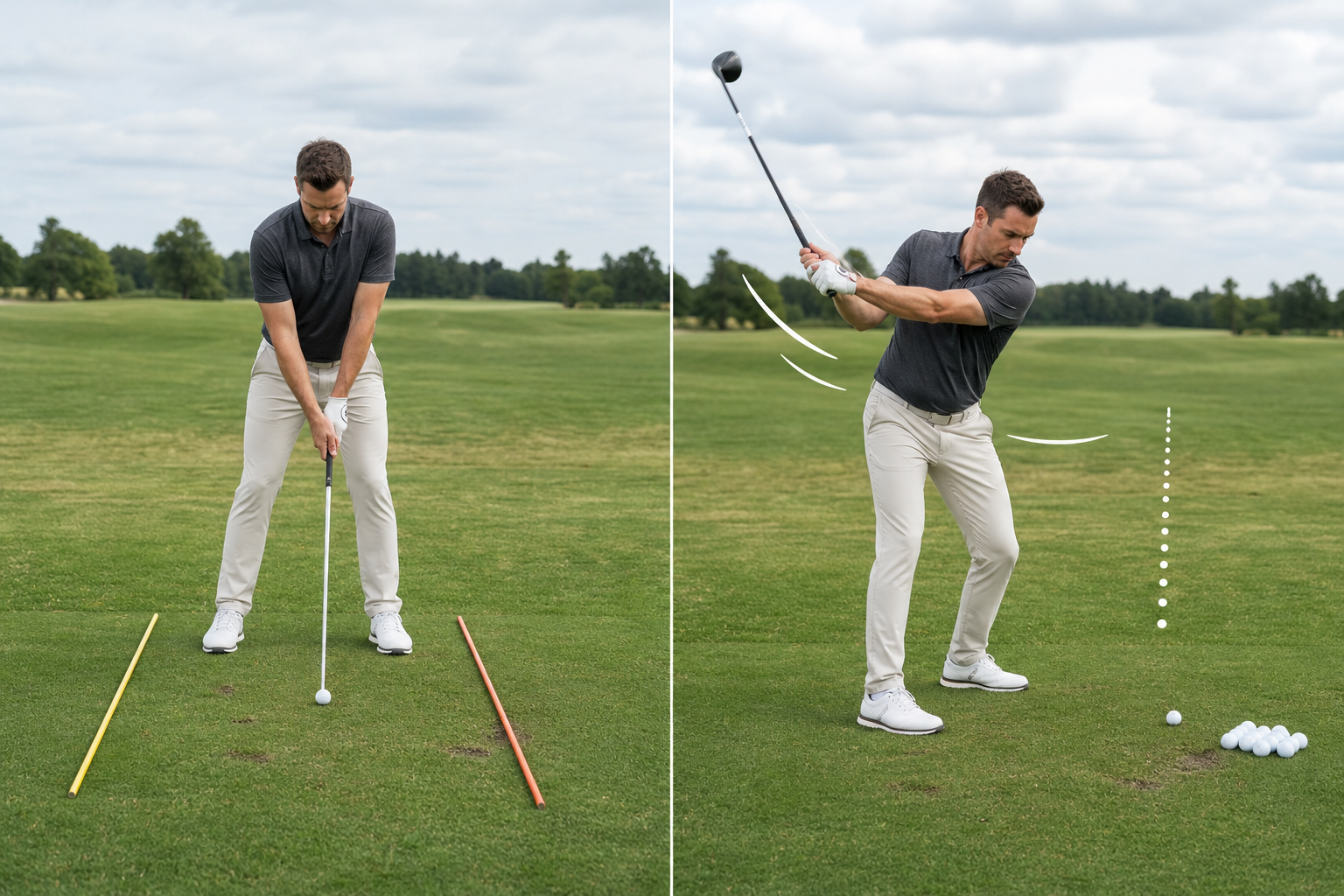
Built for: Golfers choosing between inexpensive practice aids for alignment, movement, rhythm, or speed awareness.
A practice aid is useful only when it makes one relevant mistake easier to see or one useful motion easier to repeat. Alignment sticks create visible reference lines; a tempo trainer gives the swing a movement-and-rhythm reference. Choose the feedback that matches the problem you can observe.
The quick verdict
Buy alignment sticks when you need a fixed visual reference for setup, target line, or a repeatable practice station. Choose a tempo trainer when your useful practice goal is to rehearse a more consistent-feeling motion and rhythm. Neither is a shortcut for a problem you cannot define.
Best for Alignment sticks suit golfers who can point to a setup or directional pattern, such as repeatedly aiming away from the intended start line. A tempo trainer suits golfers whose practice swings and struck shots feel rushed, abrupt, or inconsistent in rhythm.
Skip it if Skip both for now if you cannot name an observable practice goal. Start by watching where a small group of shots starts and finishes, or seek instruction if the pattern is persistent and unclear.
Begin with the miss or movement you can see
The familiar range mistake is buying the aid that looks busiest, then using it for ten minutes without learning what changed. A better starting point is the shot pattern in front of you. Perhaps your seven-iron repeatedly begins well right of a chosen flag. Perhaps it begins in several different directions. Or perhaps the contact and direction change from swing to swing when you feel rushed from the top. These are different practice problems, so they call for different feedback.
Purposeful practice links the activity to a specific goal. Before choosing an aid, write a short sentence that can be checked during one bucket: “I want to see where my shots start,” “I want a reliable target reference at address,” or “I want to rehearse a balanced, unhurried motion.” If the sentence describes a line or position, favor the visual reference of sticks. If it describes cadence or how the motion is organized, favor a tempo trainer.
Guild recommendation: Do not buy by category. Buy the aid that lets you observe one defined practice outcome within a single session.
What alignment sticks make easier to see
Alignment sticks are most useful as plain reference lines. Lay one on the ground to clarify the intended target line, or use two sticks to create a corridor that makes a practice station consistent from ball to ball. Their value is not that they prescribe a swing. Their value is that they remove guesswork about where you placed the ball, club, feet, and intended line.
Consider the golfer who aims at a flag but sees shots start consistently left. A stick on the ground gives that golfer a stable target reference before changing anything else. The next useful observation may be that the ball still starts left even when the station is clearly aimed. That is valuable information, but it is not proof of a particular swing fault. Sticks help separate a visible setup reference from the result.
Choose simple, portable sticks if you want multiple uses from one inexpensive tool. Skip elaborate features if your real need is merely a line on the ground; extra mechanisms can slow the routine without making the reference clearer.
Guild recommendation: Choose alignment sticks for target-line awareness, repeatable setup stations, and drills where an external line is the feedback you need.
What a tempo trainer makes easier to repeat
A swing tempo trainer belongs in a different lane. It is for a golfer trying to establish a more repeatable movement feel, especially when practice swings become abrupt, hurried, or difficult to finish in balance. A weighted model changes the sensation of the club moving through the swing; an audio model supplies an external rhythm cue. In either case, the useful question is simple: can you make several controlled rehearsals with a similar cadence and balanced finish?
Imagine a player who starts a few balls near the target, then becomes increasingly quick between shots and loses a stable finish. A tempo trainer can be a practical reset between balls because it turns the next rehearsal into a repeatable movement task. It does not tell the player exactly why a shot curved, and it should not be treated as a speed promise. Its feedback is about the rhythm and feel of the motion, not a diagnosis.
Avoid a trainer with settings or complexity you will not use. The right model should make a short, calm rehearsal easy enough to repeat, then easy enough to put away when it is time to hit a shot.
Guild recommendation: Choose a tempo trainer for rehearsing cadence, movement awareness, and balanced finishes—not for measuring alignment or explaining ball flight.
Use the right aid for the right range scenario
A player preparing for a narrow tee shot may benefit more from alignment sticks. Set a clear target line, hit a modest number of shots, and record whether the ball begins near the intended target. The observable result is direction, not whether the station looked impressive.
A player who becomes quick after a poor shot may benefit more from a tempo trainer. Use it for a few rehearsals, then hit an easy shot with a balanced finish as the only movement goal. The observable result is whether the swing felt more repeatable and whether the shot-start pattern became less scattered across a small sample.
Some golfers will eventually use both. That makes sense when the needs are genuinely separate: sticks for the station, trainer for the rehearsal. Do not combine every drill at once. Too many cues make it difficult to know which feedback helped.
Guild recommendation: If you can describe the issue as “where am I aimed or starting the ball?” begin with sticks. If it is “how do I stop rushing and rehearse a steadier motion?” begin with a tempo trainer.
Keep practice aids in their proper place on the course
Practice aids are designed for practice feedback, not as automatic on-course solutions. Equipment and its use during a stipulated round are governed by the applicable Rules of Golf and equipment rules. If you are considering bringing any training device into a competition or using it during a round, check the rules and the event’s conditions before relying on it.
The cleaner approach is to do the work before the round. Use the aid to establish one simple reference at the range, then take a concise playing cue to the first tee: a chosen intermediate target, a calm rehearsal, or a balanced finish. The course is for playing the shot, not recreating a full training station.
Guild recommendation: Use practice aids to build a simple routine away from competition, then confirm what is permitted before using any device during a stipulated round.
Try this · 15 minutes.
Ten-Ball Start-Line and Rhythm Check
At a safe practice area, place one alignment stick on the ground a few inches outside the ball-to-target line, far enough away that it cannot interfere with the club. Pick a distant target. If you own a tempo trainer, keep it nearby, but do not use it for the first five balls.
- Hit five easy shots with one club, using the ground stick only as a target-line reference. After each shot, note whether the ball started left of, near, or right of the distant target.
- If your starts cluster on one side, leave the setup unchanged and hit five more easy shots while aiming to begin the ball nearer the target. The goal is observation and a calmer repeat, not a swing overhaul.
- If the starts vary widely and your motion feels hurried, put the ball aside. Make five unhurried rehearsal swings with a tempo trainer or your normal club, finishing in balance each time.
- Return to the ball for five easy shots. Keep the same simple intention: a balanced finish and a start line closer to the target than in the first set.
What progress looks like: The session is useful when you can state one clear result, such as “most shots began right of the target” or “my second set began in a tighter area while I finished in balance.”
Put the guide to work
These searches are a starting point—not a substitute for the fit and comparison criteria above.
Compare alignment sticks
Compare length, weight, durability, and whether the sticks are simple enough to lay down quickly for a repeatable target-line station.
Compare weighted swing tempo trainers
Compare overall feel, portability, and whether the trainer is straightforward enough to support a consistent rehearsal rather than add a complicated routine.
Compare audio swing tempo trainers
Consider this category only if an audible rhythm cue is more useful to you than the feel of a weighted training club.
If you buy through these links, Guild of Golf may earn a commission at no extra cost to you.
The practical takeaway
- Start with an observable problem, not a product category.
- Alignment sticks provide external, visible reference lines for target direction and practice setup.
- Tempo trainers provide movement and rhythm feedback for controlled rehearsals and balanced finishes.
- A small, repeatable practice sample is more useful than stacking several drills together.
- Check applicable rules before using a training device during a stipulated round.
Frequently asked questions
Should a beginner buy alignment sticks or a tempo trainer first?
Choose the one that answers the clearest immediate question. A beginner who needs a visible target-line reference should start with alignment sticks. A beginner whose main issue is rushing through every rehearsal may get more value from a simple tempo trainer. If neither need is clear, delay the purchase and first observe a short set of shots.
Can alignment sticks fix a slice or hook?
Alignment sticks can make your intended target line and setup reference easier to see. They do not, by themselves, identify the cause of a curve or guarantee a ball-flight change. Use them to make the practice environment consistent and observe the result.
Will a tempo trainer increase swing speed?
A tempo trainer is best treated as a rhythm and movement-rehearsal tool. It may help a golfer practice a more repeatable-feeling motion, but it should not be purchased with a promised speed outcome in mind.
Can I use both aids in one session?
Yes, but give each a distinct job. Use sticks to establish a target reference, then use a tempo trainer for a few rehearsals if rhythm is the separate goal. Keep the session simple enough that you can tell what feedback was useful.
Are practice aids allowed during a golf round?
Equipment and use during a stipulated round are governed by applicable rules. Review the relevant Rules of Golf, equipment rules, and any competition conditions before using a training device during a round.
Sources used for this draft
- PGA of America: Practice With Purpose — The principle that purposeful practice connects an activity to a specific goal.
- USGA Equipment Rules — The note that equipment and its use during a stipulated round are governed by applicable rules.
Guild of Golf may earn a commission from qualifying purchases made through shopping links, at no additional cost to the reader.